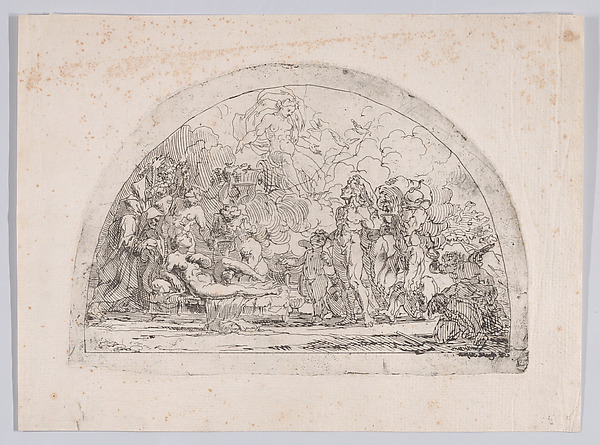
Triumph of Death: Three Skeletons Invading a Bacchanal Orchestrated by a Magician or an Evil Demon
SEE IT IN PERSON
Not currently on view
In the collection of Art Institute of Chicago, Chicago · as of July 2026
Discussion
FROM THE ART INSTITUTE OF CHICAGO’S CATALOG
Fuseli often dwelled on the macabre and the sensational, as in this drawing, and occasionally allowed his unconscious mind to dictate his subject matter. “For if these images so pursue us when our minds are in a kind of waking dream,” he wrote, “why should we not use this vice of the mind?” Fuseli’s art played a role in his age’s taste for the Gothic. It was an era that saw the emergence of distinctly modern forms of cultural consumption: romances, sentimental novels and, most important, Gothic novels and plays focusing on themes of terror and the supernatural. As Fuseli’s student Benjamin Haydon wrote, “Amongst all classes [Fuseli] was considered a painter of horrors.”
Be the first to share your thoughts.
Sign in to join the discussion.
More by Henry Fuseli
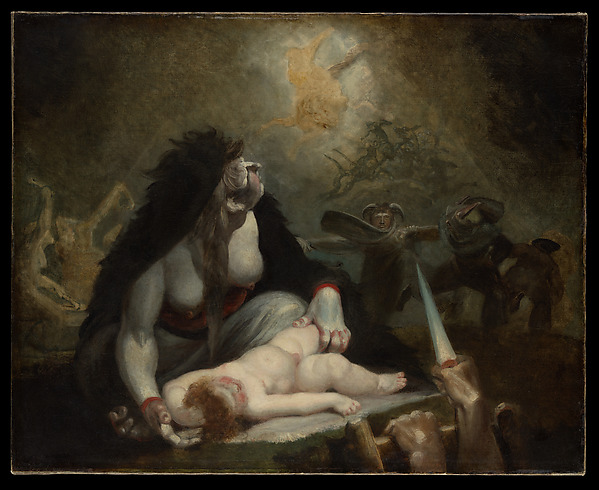 The Night-Hag Visiting Lapland Witches
 Two Heads of Damned Souls from Dante's "Inferno" (front and
  Milton Dictating to His Daughter
 Perseus Starting from the Cave of the Gorgons
 Sketch for 'Dido on the Funeral Pyre' (recto); Erotic Sketch
 Study for Inquisition, Illustration to Columbiad
 Hagen and the Nymphs of the Danube
 Prospero, Miranda, Caliban and Ariel
More like this
 Unknown artist — Group of Figures
 Thomas Stothard — Frieze of Warriors
 Jean Louis André Théodore Géricault — Sketches of an Equestr
 Giovanni Battista Beinaschi — Glory of Angels
 Giovanni Battista Cipriani — Sketches of Mythological Subjec
 Peter Paul Rubens (Flemish, 1577–1640) — Reconciliation of t
 Nicolas-François Chifflart (French, 1825–1901) — Sheet of Sk
 Raymond de Lafage — Sketches of Six Classical Figures
 Antonio Puglieschi — Exaltation of the Holy Cross
 Erasmus Quellinus — Triumph of Bacchus
 Pietro Testa — Bacchante
 André Jean Lebrun — An Allegory of the Arts Vanquishing Time