Theodore Meets in the Wood the Specter of His Ancestor Guido Cavalcanti, Chasing with Mastiffs His Former Disdainful Mistress
SEE IT IN PERSON
Not currently on view
In the collection of Art Institute of Chicago, Chicago · as of July 2026
Discussion
FROM THE ART INSTITUTE OF CHICAGO’S CATALOG
The story that Fuseli illustrated here concerns Theodore, a young nobleman of Ravenna rejected by the beautiful but proud Honoria, with whom he is infatuated. In despair, Theodore retires to his country estate where one day he encounters the ghost of his ancestor Guido Cavalcanti, a suicide condemned in the afterlife to perpetually chase, kill, and disembowel the woman who rejected his love. Honoria witnesses the scene, which transforms her feelings for Theodore. Fuseli’s source was the English poet John Dryden’s verse translation (published 1700) of a story from the Italian author Giovanni Bocaccio’s Decameron (written 1349–53).
Be the first to share your thoughts.
Sign in to join the discussion.
More by Henry Fuseli
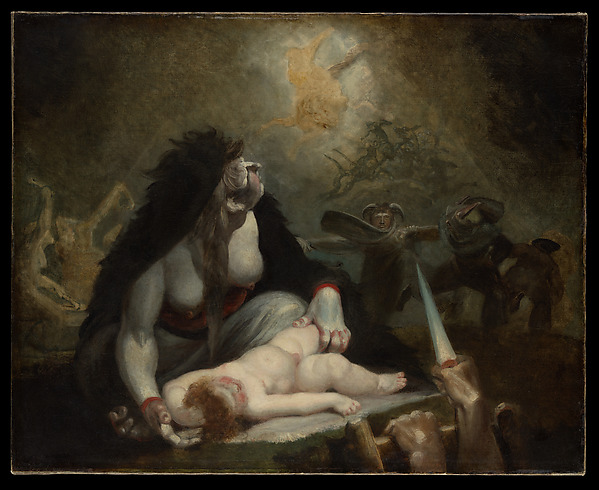 The Night-Hag Visiting Lapland Witches
 Two Heads of Damned Souls from Dante's "Inferno" (front and
  Milton Dictating to His Daughter
 Perseus Starting from the Cave of the Gorgons
 Sketch for 'Dido on the Funeral Pyre' (recto); Erotic Sketch
 Study for Inquisition, Illustration to Columbiad
 Hagen and the Nymphs of the Danube
 Prospero, Miranda, Caliban and Ariel
More like this
 Unknown Marchigian — Angel Appearing to Saint Francis of Ass
 Giovanni Paolo Panini — Studies of Male Figures
 Luca Cambiaso — Mars and Cupid
 Otto van Veen — Judgement of Paris
 Unknown — Mythological Scene with Woman Bathing
 Stefano della Bella — Study for Satyr Family Walking (recto)
 Hubert François Gravelot — Study for Vignette in Fontenelle'
 Claude Lorrain — Nymphs and Satyrs Playing Musical Instrumen
 Follower of Charles Le Brun — Putto Firing at Putto on Horse
 Giovanni Antonio da Pordenone — Conversion of St. Paul (rect
 Cesare Pollini — Triumph of Bacchus with Drunken Silenus on
  Hubert François Gravelot — Study for Vignette in Fontenelle'