Who Was Berthe Morisot?
The founding Impressionist who was painted more often than she was remembered.
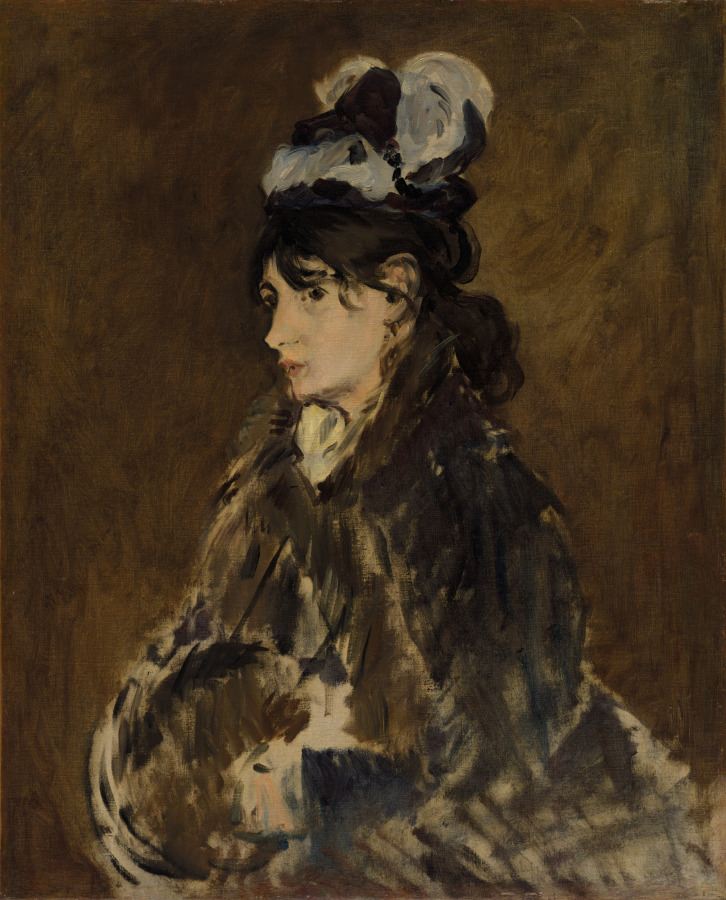
Berthe Morisot (1841–1895) was a French painter and one of the founding members of Impressionism — the only woman in the movement’s landmark first exhibition in 1874. Admired by her peers in her lifetime, then long overlooked, she painted women and everyday domestic life with a daringly loose, luminous touch.
The face above belongs to Berthe Morisot — but the hand that painted it was Édouard Manet's. That is the paradox of her story: for a long time she was better known as the woman in the paintings than as one of the finest painters of her generation.
A painter, not a muse
Morisot trained seriously from her teens, copying at the Louvre and studying briefly with the landscape master Camille Corot. By her early thirties she was exhibiting alongside Claude Monet, Renoir, and Degas in the 1874 show that gave Impressionism its name — the only woman in the group. She showed in seven of the eight Impressionist exhibitions, missing only the one held just after her daughter was born.
Her subjects were the world she was allowed to move through: women reading, dressing, gardening, mothers with children, quiet interiors. She painted them with fast, open brushwork that many critics of the day found unfinished — and that we now see as the whole point.

The Manet question
Morisot met Manet around 1868, and he painted her again and again — at least eleven times. The portraits are charged, intimate things, and it's long been rumored that the two were in love. We want to be clear: that has never been proven, and it belongs to the realm of speculation, not fact. What the record shows for certain is this — in 1874, Berthe married Manet's younger brother, Eugène. As the story goes, some of the family's letters were quietly thinned out in later years; what survives shows a deep, complicated closeness and nothing more can honestly be claimed. She kept the Manet name and the Manet circle for the rest of her life.
Why you may not have learned her name
Morisot sold well and was respected by the very artists we now call masters. But after her death in 1895 — caught nursing her daughter through the flu — her reputation faded as the story of Impressionism hardened into a list of famous men. The rediscovery has been recent and overdue: major retrospectives in the last decade have restored her to the center of the movement she helped invent.
If you've reacted to an Impressionist canvas on DiscoverArt and felt that loose, light-filled looseness, there's a good chance Morisot helped teach the movement how to do it.
Sources
- Berthe Morisot — Wikipedia
- Berthe Morisot, Woman Impressionist — Musée d’Orsay / Barnes Foundation exhibition (2018–19)
- Édouard Manet — The Met, Heilbrunn Timeline of Art History
Discussion
Be the first to share your thoughts.
Sign in to join the discussion.