The Actress in Three Masterpieces
Degas made her tragic. Manet made her lonely. Renoir made her the life of the party. Same woman.

Ellen Andrée, a Parisian actress and one of the most sought-after models of the Impressionist era. Degas painted her slumped over absinthe in L’Absinthe (1875–76), Manet painted her waiting alone in Plum Brandy (c. 1877), and Renoir seated her among friends in Luncheon of the Boating Party (1880–81) — three masters, three completely different women, one face.
Three of the most famous paintings of the Impressionist era share a secret. One shows a woman hollowed out beside a glass of absinthe. One shows a woman waiting alone with an unlit cigarette. One shows a woman laughing at the best lunch party ever painted.
They are the same woman.
The actress
Her name was Ellen Andrée — a Parisian stage actress and, for a decade, one of the most sought-after models in the city. The painters of modern life needed faces that could perform modern life, and nobody performed it better. What happened next is one of art history's quietest lessons: three of the greatest painters who ever lived looked at the same woman and saw three entirely different worlds.
Act I — Degas makes her tragic

Degas posed her at the Café de la Nouvelle-Athènes on Place Pigalle beside the painter Marcellin Desboutin — two strangers at one table, together and utterly alone. In front of her: absinthe, the era's most infamous drink. Her eyes are down, her shoulders emptied. He first called it simply Dans un café.
The world reacted as if she were a real casualty. Early critics called the picture ugly and disgusting, and at its scandalous 1893 London showing — now titled L'Absinthe — the critic George Moore sneered, "What a whore! … the tale is not a pleasant one, but it is a lesson." He later retracted it, admitting the picture "is merely a work of art, and has nothing to do with drink or sociology." He was closer the second time: Ellen Andrée was acting, and the despair the critics moralized over was a performance she delivered on request.
Act II — Manet makes her lonely
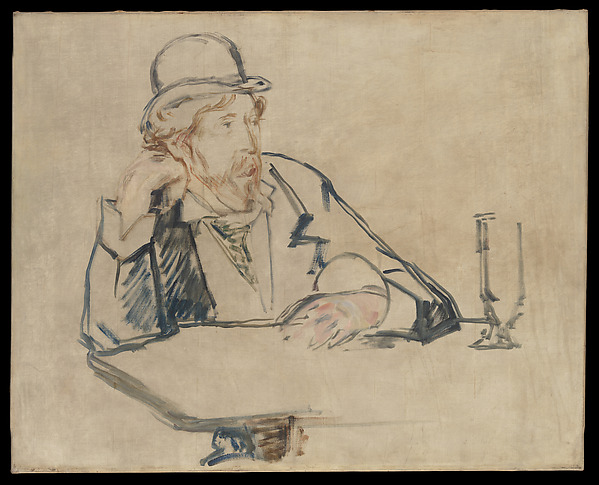
A year or so later, Manet sat the same actress in a café setting of his own — likely inspired by the very same Nouvelle-Athènes — and answered Degas with tenderness. She wears soft pink. Before her sits a plum soaked in brandy, untouched. In her hand, a cigarette — unlit, with no matches anywhere on the table.
That unlit cigarette is the painting's quiet heartbreak. As the story is usually told, she's waiting — for a light, for company, for someone who hasn't come. X-rays reveal Manet originally painted a beer glass and changed it to the gentler plum as he worked. Where Degas painted despair already arrived, Manet painted the moment before — loneliness that might still be interrupted.
Act III — Renoir makes her radiant
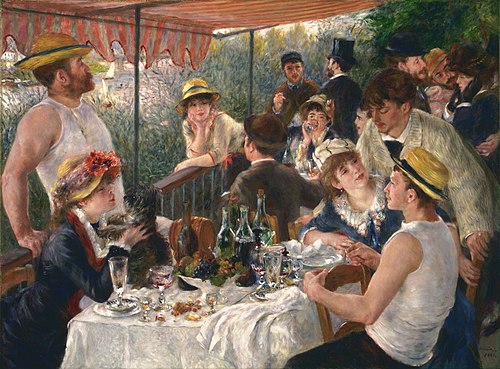
Then came Renoir. On a restaurant terrace above the Seine at Chatou, he painted fourteen friends finishing a long, golden lunch — and there, mid-table, glass raised, is Ellen Andrée. The woman who embodied café despair for Degas and quiet longing for Manet is, in Renoir's world, sunlight itself. Around her sit Renoir's future wife Aline Charigot (playing with her little dog) and the painter Gustave Caillebotte — the whole gang of a movement at its happiest.
Three masters, one mirror
Line the three up and something remarkable happens: the paintings stop being about her and start being about them. Degas, the unflinching observer, found the ache in the modern city. Manet, the sympathetic one, found the hope inside the ache. Renoir — who once said he wanted painting to be something joyful — found the party. It was rumored these men measured themselves against each other constantly; whether or not each canvas was an answer to the last, the conversation between them is right there on the walls.
And the woman at the center of it all walked out of the frame each evening and went back to the theater — the only person who ever saw all three versions of herself and knew that none of them, and all of them, were true.
Where do you land — Degas's honesty, Manet's mercy, or Renoir's joy? Add your voice below.
Sources
- L’Absinthe — Wikipedia
- Plum Brandy — Wikipedia
- Luncheon of the Boating Party — Wikipedia
- Dans un café (L’Absinthe) — Musée d’Orsay · Plum Brandy — National Gallery of Art
Discussion
Be the first to share your thoughts.
Sign in to join the discussion.