What Is Post-Impressionism?
Four very different artists, one restless question: what comes after the impression?

Post-Impressionism is the name for a diverse wave of art (roughly 1885–1905) that grew out of Impressionism but pushed beyond capturing light. Its major figures — Van Gogh, Cézanne, Seurat, and Gauguin — kept vivid color but added personal emotion, solid structure, and symbolism. Less a single style than a shared restlessness, it opened the door to modern art.
Post-Impressionism is one of those tidy-sounding labels that covers a genuinely untidy moment. There is no single Post-Impressionist look, no shared manifesto, no group that met and named itself. What holds it together is a mood — a generation of painters who had absorbed Impressionism's bright color and then grown restless with it, each striking out in a different direction at once.

Where did the term come from?
The term was coined after the fact by the British critic Roger Fry, who organized a landmark 1910 London exhibition titled Manet and the Post-Impressionists. The artists it describes never called themselves Post-Impressionists — most were dead by the time the word existed. Fry simply needed a name for the wave of painters who came after the Impressionists and clearly owed them something, yet just as clearly were doing something new.
That backward-looking origin is worth remembering. "Post-Impressionism" is a convenient bin, not a club anyone joined. Fry chose the name partly out of honesty — he could see these painters had moved past Impressionism but could not name a single thing they had all moved toward. The vagueness is baked in, and it is why the label has stuck for more than a century.
Who were the Post-Impressionists?
The Post-Impressionists were a handful of highly individual artists who kept Impressionism's vivid palette but each added something of their own. The four names that anchor the story:
- [Vincent van Gogh](/artist/Vincent%20van%20Gogh) — raw emotion and expressive color, paint laid on thick enough to feel like weather.
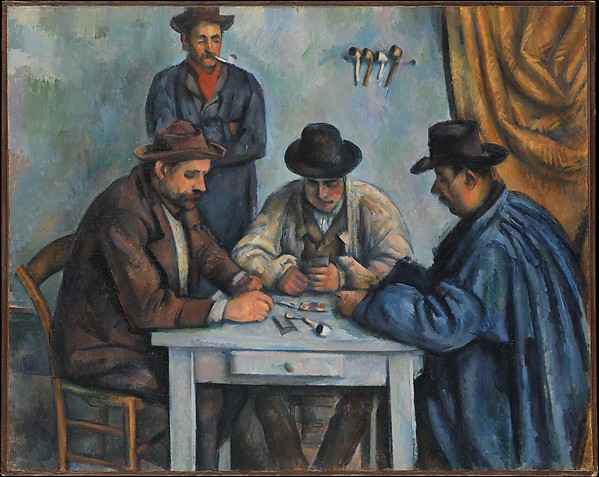
- [Paul Cézanne](/artist/Paul%20C%C3%A9zanne) — solid structure, breaking the world into planes and volumes that would later inspire Cubism.
- [Georges Seurat](/artist/Georges%20Seurat) — science and precision, building images from tiny dots of pure color.
- Paul Gauguin — symbolism and flat, bold color, chasing meaning over appearance.
Set two of them side by side and the range is obvious. Cézanne's patient geometry could hardly be further from Van Gogh's fever, yet both belong here.

How is it different from Impressionism?
Post-Impressionism differs from Impressionism mainly in intent: where the Impressionists tried to record how a moment looked, the Post-Impressionists used color and form to express feeling, structure, and meaning. The palette carried over; the purpose changed. We break the comparison down in Impressionism vs. Post-Impressionism.
Because it pointed toward emotion, abstraction, and design rather than pure observation, Post-Impressionism is often called the doorway to modern art. Everything from Fauvism to Cubism traces back through these few restless painters.
To feel the range for yourself, read about who Van Gogh was and who Cézanne was, then set their work side by side on DiscoverArt and see how differently two contemporaries could look at the world.
Sources
Discussion
Be the first to share your thoughts.
Sign in to join the discussion.