What Is Impressionism? A Beginner’s Guide
The movement that got laughed out of the Salon — and then conquered the world.

Impressionism was a 19th-century French art movement that broke from academic tradition to capture fleeting light, color, and everyday modern life with loose, visible brushstrokes. Led by artists like Monet, Renoir, and Degas, it took its name — mockingly at first — from Monet’s 1872 painting “Impression, Sunrise.” Rejected by critics, it became the most popular movement in art.
Impressionism is probably the most beloved movement in the history of painting — the sunlit gardens, the dappled rivers, the dancers and cafés. What's easy to forget is that it began as a scandal. When a handful of French painters first showed this work in the 1870s, critics mocked it as unfinished and sloppy. Here's how a joke became a revolution.

Where did the name come from?
The name came from an insult. In 1874 a group of artists, tired of being rejected by the official Salon, mounted their own independent exhibition in Paris. Among the paintings was Claude Monet's misty harbor scene Impression, Sunrise. A critic seized on the title and sneered that the works were mere "impressions" — sketches, not real pictures.
The artists cheerfully adopted the jab as their banner. If you want the fuller story of that hostile reception, we tell it in why the Impressionists were rejected.
What makes a painting Impressionist?
An Impressionist painting tries to catch a fleeting moment of light rather than a polished, timeless scene. A few hallmarks show up again and again:
- Loose, visible brushwork — the strokes are left on show instead of blended smooth.
- Painting outdoors — working en plein air, in front of the real subject, to chase changing light.
- Modern, everyday subjects — boating parties, train stations, streets, and gardens, not gods and history.
- Pure, bright color — dabs of unmixed paint placed side by side, so your eye blends them.
- Shadows full of color — blues and violets instead of flat brown or black.

Who were the Impressionists?
The Impressionists were a loose circle of friends and rivals working around Paris, not a formal club. The best-known names are Monet, Pierre-Auguste Renoir, and Edgar Degas, joined by Camille Pissarro, Alfred Sisley, and two remarkable women who are too often left out: Mary Cassatt and Berthe Morisot.
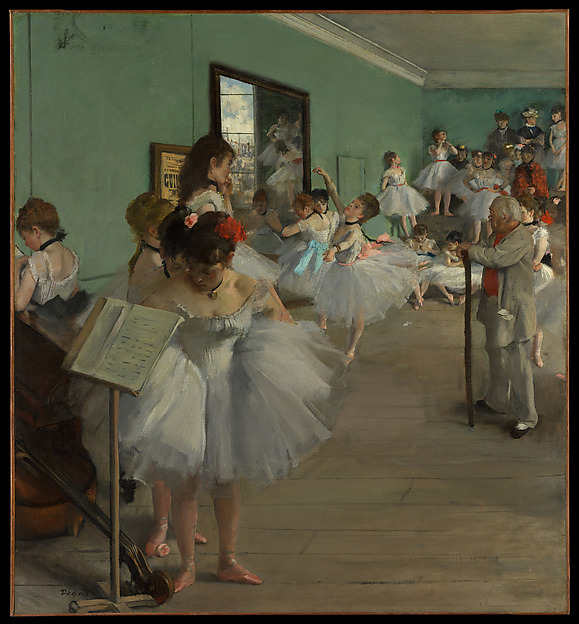
Degas, in particular, bristled at the "Impressionist" label and preferred crisp indoor scenes of dancers and theaters to sunlit fields — a reminder that the movement was always a conversation, not a rulebook.
Morisot was a founding member who exhibited in nearly every group show, and you can read about her in who was Berthe Morisot. If you're curious where the story goes next — into Van Gogh, Cézanne, and Seurat — see Impressionism vs. Post-Impressionism.
The best way to understand Impressionism, though, is simply to look. Start reacting to a few paintings on DiscoverArt and notice which flickers of light catch you.
Sources
Discussion
Be the first to share your thoughts.
Sign in to join the discussion.