Relief Plaque
SEE IT IN PERSON
Not currently on view
In the collection of Art Institute of Chicago, Chicago · as of July 2026
Discussion
FROM THE ART INSTITUTE OF CHICAGO’S CATALOG
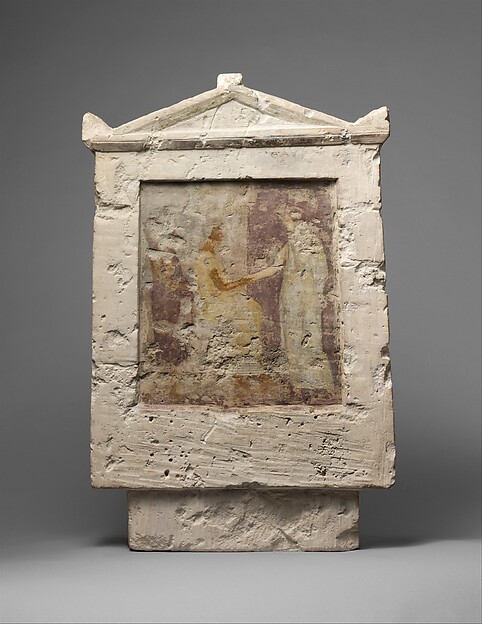
During the early Roman Empire, terra-cotta relief plaques were a popular form of interior decoration for houses, public baths, and tombs. The mold-made reliefs, which could be rapidly reproduced to create a decorative frieze, reflect an interest in older Greek styles. Here female temple attendants, whose costumes and hairstyles recall fashions worn at least 200 years earlier by the Greek occupants of southern Italy and Sicily, kneel before a tall incense burner, upon which they place an offering. The scene is bordered by an egg-and-dart pattern above and a lotus pattern below. The presence of four nailholes indicates that these panels were likely affixed to a wall.
Be the first to share your thoughts.
Sign in to join the discussion.
More by Ancient Roman


More like this
 Ancient Greek — Fragment of a Funerary Lekythos (Monument in
 Pakistan
Khyber Pakhtunkhwa Province, ancient region of Gand
Pakistan
Khyber Pakhtunkhwa Province, ancient region of Gand Ancient Greek — Fragment of a Funerary Naiskos (Monument in
  Ancient Greek — Statuette of a Seated Girl
 Lombard — Capital with Man Fighting Lion (A) and Riding Grif
 Pakistan
Ancient region of Gandhara — Corinthian Capital wit
Pakistan
Ancient region of Gandhara — Corinthian Capital wit Pakistan
Ancient region of Gandhara — Goddess Hariti Seated
Pakistan
Ancient region of Gandhara — Goddess Hariti Seated  Indonesia
Borneo, Kutai Province, Gunung Kombeng — Head of
Indonesia
Borneo, Kutai Province, Gunung Kombeng — Head of  Ancient Greek — Fragment of a Grave Monument
 Flemish — Two Putti Supporting a Torch
 Painted limestone funerary stele with a seated man and two s
 Italian — Capital with Eagles