In the collection of Barnes Foundation, Philadelphia — check current display status with the museum.
FROM THE BARNES FOUNDATION’S CATALOG
Van Gogh painted this sketch of a brothel parlor while working in close dialogue with fellow artist Paul Gauguin. In the fall of 1888, Van Gogh convinced Gauguin to join him in Arles in the South of France, and the two artists often painted there side by side. They also visited brothels together, partly to find figural subjects for painting. Encouraged by Gauguin, Van Gogh painted this work from memory, capturing the types of people—women in bright dresses drinking with men, soldiers wearing distinctive red hats—encountered in such a setting. He used an underlying blue wash to suggest the lurid atmosphere.
Be the first to share your thoughts.
Sign in to join the discussion.
 Henri de Toulouse-Lautrec — Moulin de la Galette
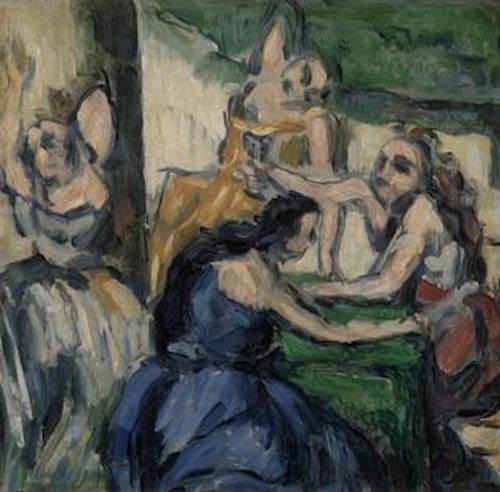 Paul Cézanne — The Courtesans (Les Courtisanes)
 Henri de Toulouse-Lautrec — The Ladies in the Dining Room
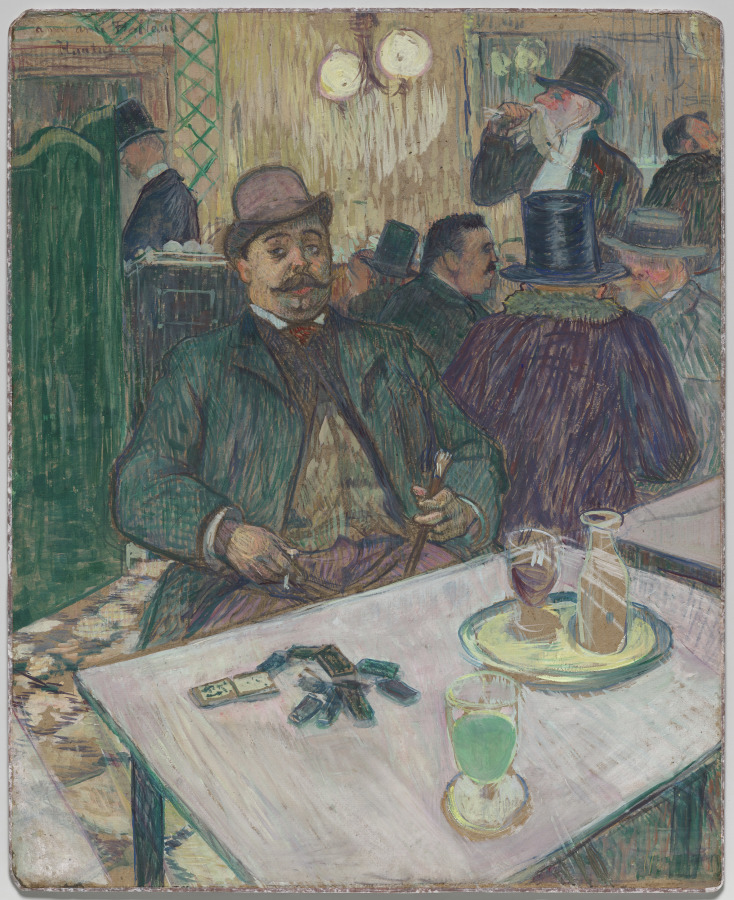 Henri de Toulouse-Lautrec (French, 1864–1901) — Monsieur Boi
 Ernst Ludwig Kirchner — Tavern
 Édouard Vuillard — The Little Restaurant (Le petit restauran
 Edvard Munch — Drinkers
 Giovanni Boldini — Feast Scene
 Henri de Toulouse-Lautrec — At the Moulin Rouge
 Henri de Toulouse-Lautrec — A Corner of the Moulin de la Gal
 Henri de Toulouse-Lautrec — At the Table of Monsieur and Mad
 Pierre-Auguste Renoir — Bal du moulin de la Galette


