Prout's Neck, Breakers
SEE IT IN PERSON
Not currently on view
In the collection of Art Institute of Chicago, Chicago · as of July 2026
Discussion
FROM THE ART INSTITUTE OF CHICAGO’S CATALOG
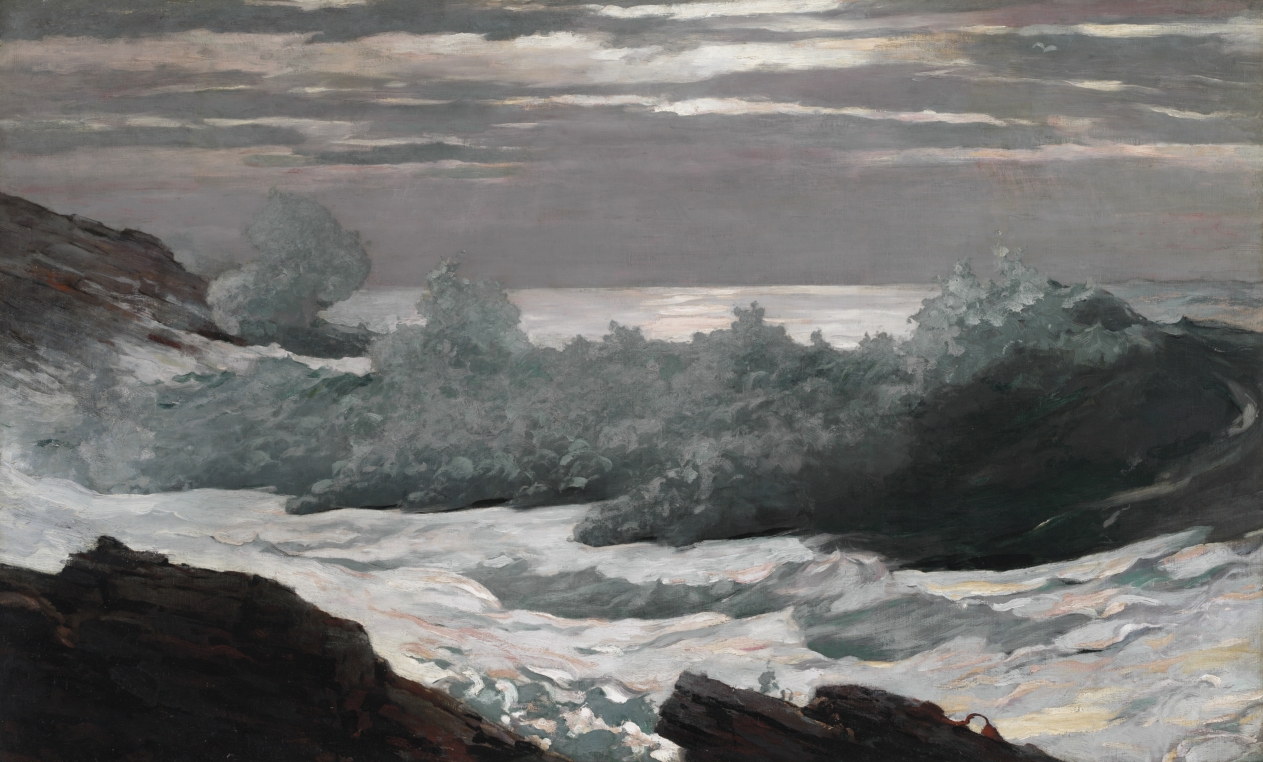
Homer’s decision to move to Maine in 1883 presumably indicated his desire to live close to nature—Prout’s Neck was a peninsula known for its rocky coastline and dramatic views of the Atlantic Ocean. Prout’s Neck, Breakers , later the model for the monumental oil painting Early Morning after a Storm at Sea , shows the artist’s continued fascination with the power of the sea. However, unlike his earlier marine works, this and other watercolors made at Prout’s Neck are usually devoid of human activity, exploring nature’s grandeur in its many manifestations. This work also exemplifies important aspects of Homer’s technique as a watercolorist, including the way he layered strokes of color—using a range of light and dark blues—to create the depth and force of the breaking waves. He used the white of the paper to produce a brilliant sheen on the sea, juxtaposed with a hazy sky above.
Be the first to share your thoughts.
Sign in to join the discussion.
More by Winslow Homer




More like this
 Winslow Homer (American, 1836–1910) — Early Morning After a
  Auguste Louis Lepère (French, 1849–1918) — Storm on the Isla
 William Henry Drake (American, 1856–1926) — Tail Piece for C
 Gustave Courbet — Marine: The Waterspout
 William Trost Richards (American, 1833–1905) — Cormorant Cli
 Frank K. M. Rehn (American, 1848–1914) — An October Day
 Emile Adélard Breton — The Breakers
 John Glover — Barren Coast and Slight Storm
 Dwight Blaney (American, 1865–1944) — Over the Ledges
 Anthony Vandyke Copley Fielding (British, 1787–1855) — Marin
 Gustave Courbet — The Sea
 Thomas Doughty — Coming Squall (Nahant Beach with a Summer S