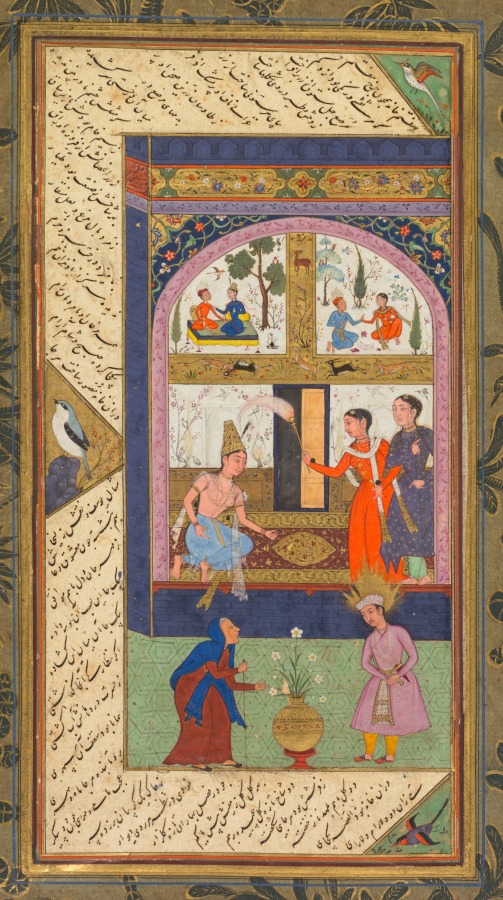
Zal Climbing to Rudaba, page from a copy of the Shahnama of Firdausi
SEE IT IN PERSON
Not currently on view
In the collection of Art Institute of Chicago, Chicago · as of July 2026
Discussion
FROM THE ART INSTITUTE OF CHICAGO’S CATALOG
Among the most beautiful examples of Islamic art are the illuminated manuscripts from Persia that portray legendary tales of heroism, love, and adventure. Zal Courting Rudabahis a page from a 16th-century version of the Book of Kings,the national epic of Persia. Below the lovers seen on the balcony are attendants, animals, architecture, flowering plants, and calligraphy (revered as an art form throughout the Islamic world), all carefully integrated into a rich, overall pattern. The painting's jewel-like quality is enhanced by its brilliant colors, including gold and blue, formed from the precious stone lapis lazuli.
Be the first to share your thoughts.
Sign in to join the discussion.
More by Islamic


More like this
 Uzbekistan
Bukhara — Judge (Qazi) of Hamadan in a Drunken St
Uzbekistan
Bukhara — Judge (Qazi) of Hamadan in a Drunken St Uzbekistan
Bukhara — Chained Prisoners are Brought Before a
Uzbekistan
Bukhara — Chained Prisoners are Brought Before a  Miskin (Indian, active 1570s–c. 1604) — An Ambassador before
 Babur meeting with Sultan Ali Mirza at the Kohik River, from
 Yusuf Ali (Indian, active early 1600s) — A charioteer riding
 Encampment in the Mountains
 India
Kashmir — Prince Visiting an Ascetic during a Hunt
India
Kashmir — Prince Visiting an Ascetic during a Hunt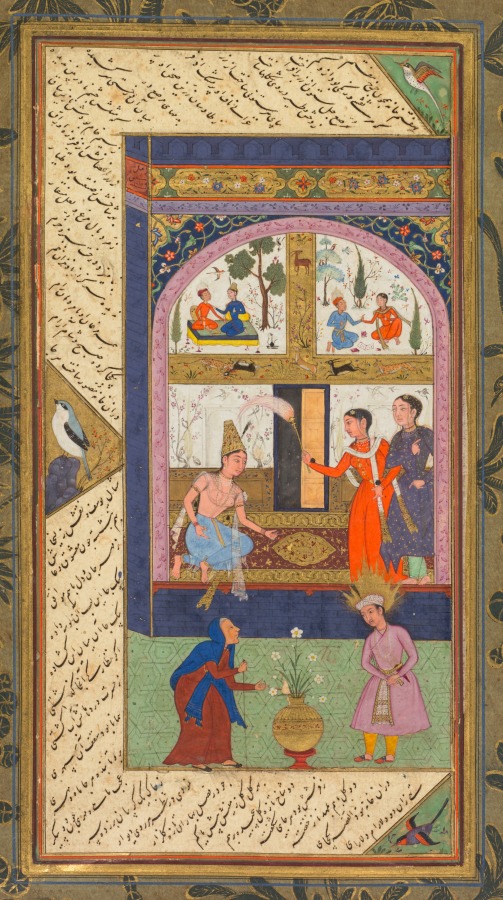 Mushfiq (Indian, active early 1600s) — Zulaykha in her palac
 Mushfiq (Indian, active early 1600s) — Folios A and B from t
 Iran
Shiraz, Fars — Iskander Comforts the Dying Darius
Iran
Shiraz, Fars — Iskander Comforts the Dying Darius Alamshah cleaving asunder the chain of the wheel, from volum
 Battle between Manuchihr and Tur, from a Shah-nama (Book of