10 Famous Paintings You Can Explore Online for Free in 2026
The world's great museums have opened their collections. Here's where to start looking — tonight, for free.

In 2026, many of the world's most famous paintings are free to explore online through museum open-access programs. You can zoom into Seurat's "A Sunday on La Grande Jatte" and Van Gogh's "The Bedroom" (Art Institute of Chicago), Degas's dancers and Hokusai's "Great Wave" (the Met), Vermeer's "Girl with a Pearl Earring," Monet's water lilies, and Cassatt's "The Child's Bath" — all in high resolution, all free.
Something quietly radical happened over the last decade: the world's great museums put their collections online and, in many cases, made the images free to use. The Metropolitan Museum of Art, the Art Institute of Chicago, the Cleveland Museum of Art, and the Rijksmuseum all release high-resolution, public-domain images of works whose copyright has expired. That open-access movement is exactly why DiscoverArt can show you these paintings at all — and why you can explore ten famous ones tonight, for free.
1. A Sunday on La Grande Jatte — Georges Seurat
Seurat built this park scene entirely from tiny dots of color, a method he called divisionism. Online you can zoom until the figures dissolve into pure technique — something almost impossible to do in the crowded gallery at the Art Institute of Chicago. Here's what La Grande Jatte is really about.
2. The Bedroom — Vincent van Gogh
Vincent van Gogh painted his little room in Arles three times, and the Art Institute holds one of the versions. Free and zoomable, it lets you trace the thick, deliberate brushwork and the tilting floor he used to make a plain room feel alive.

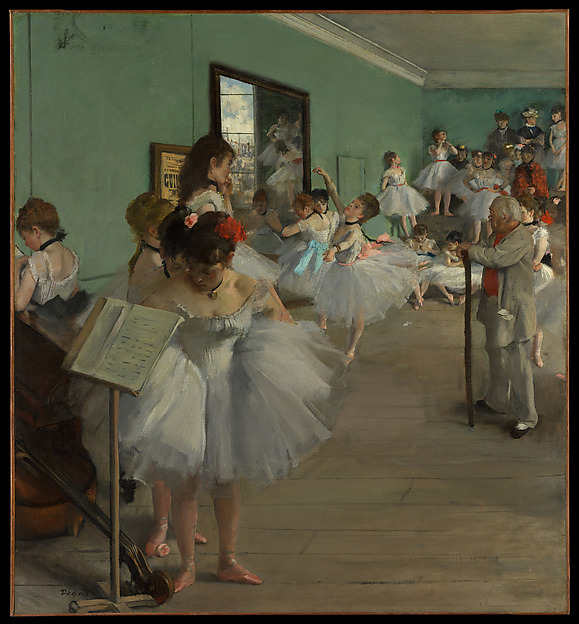
3. The Dance Class — Edgar Degas
Edgar Degas painted ballet dancers not mid-leap but mid-boredom — adjusting a slipper, scratching a back, waiting to be corrected. The Met's open-access image lets you study the offhand, snapshot composition that made him modern.
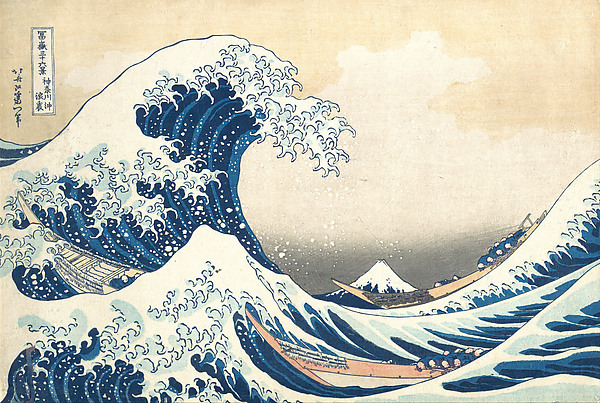
4. The Great Wave off Kanagawa — Katsushika Hokusai
Katsushika Hokusai designed the most reproduced image in the world as a woodblock print around 1831. The Met holds an impression and shares it freely, so you can finally see the tiny boats — and the small, calm Mount Fuji — the great claw of water is about to swallow.
5. Girl with a Pearl Earring — Johannes Vermeer
The Mauritshuis offers a superb high-resolution scan of Johannes Vermeer's most famous face. Up close you can see the single, loose highlight that makes the "pearl" read as a pearl — there's less there than you think. More in the secret of Girl with a Pearl Earring.
6. Water Lilies — Claude Monet
Claude Monet spent his last decades painting the pond in his garden at Giverny, often as his eyesight failed. The Art Institute's version repays slow online looking — read what changed as Monet went blind.
7. The Gulf Stream — Winslow Homer
Winslow Homer painted a lone Black sailor adrift on a dismasted boat, ringed by sharks and a distant waterspout. The Met's open image lets you weigh the tension the painting never resolves — rescue on the horizon, or not.
8. At the Moulin Rouge — Henri de Toulouse-Lautrec
Henri de Toulouse-Lautrec turned the Paris nightclub into a scene of harsh gaslight and green-tinged faces. The Art Institute's high-resolution file reveals the strange cropped figure at the edge — a face lit acid-green — that keeps the picture unsettling.
9. The Child's Bath — Mary Cassatt
Mary Cassatt painted a mother washing a child's feet with the steep, patterned viewpoint she borrowed from Japanese prints. It's tender without a drop of sweetness — see why in who was Mary Cassatt. Through January 3, 2027, the painting is the centerpiece of the Art Institute's exhibition Mary Cassatt: After Impressionism.
10. The Anatomy Lesson of Dr. Nicolaes Tulp — Rembrandt
Rembrandt van Rijn was just twenty-six when he painted this dissection scene, held today by the Mauritshuis. The free scan lets you follow every craning face as the surgeon lifts the tendons of a dead man's forearm.
Start with one and slow down
Open access means the entire history of famous painting is now a browser tab away — which is a mixed blessing, because ten more tabs are always tempting. Pick one, zoom in, and stay a while. When you're ready for the works that hang beside them, wander the collections on DiscoverArt or the most famous paintings in the world.
Sources
Discussion
Be the first to share your thoughts.
Sign in to join the discussion.