What Is Georges Seurat's "A Sunday on La Grande Jatte" About?
Two years, millions of dots, and a park full of strangers who never quite touch.

It depicts Parisians relaxing on an island in the Seine on a Sunday afternoon — but Seurat turned an ordinary scene into a vast, still, almost frozen tableau built from tiny dots of pure color. Painted 1884–86, it is the landmark of Pointillism and a quiet meditation on modern city leisure and isolation.
On its surface, it couldn't be simpler: people spending a Sunday in a riverside park. But Georges Seurat spent two years turning that ordinary afternoon into one of the strangest and most ambitious paintings of the nineteenth century — a canvas roughly two by three meters, populated by dozens of Parisians who share the same grass yet seem entirely alone.
What technique did Seurat use?
Seurat built the painting from thousands of tiny, separate touches of pure color, a method he championed as divisionism and that most people now call Pointillism. Rather than mixing green on his palette, he set dots of blue and yellow side by side and let your eye blend them from a distance. The idea was almost scientific — a belief that optical mixing would make color more luminous than any blend on the palette — and the labor behind it was enormous. He worked up the composition through dozens of small studies and drawings before committing to the final canvas, and he even repainted a dotted border around the scene so it wouldn't clash with an ordinary frame.

Why do the people look so still?
They look still because Seurat wanted them to — he drained the scene of movement on purpose, giving the figures a monumental, almost Egyptian stiffness. Profiles face forward, a woman's parasol freezes mid-stroll, a little girl in white stands at dead center, unmoving. Many viewers read this stillness as a comment on modern city life: crowds of people together but not quite connecting, leisure that looks oddly formal. That reading is an interpretation rather than a documented intention, but it's part of why the picture feels so uncanny once you notice it.
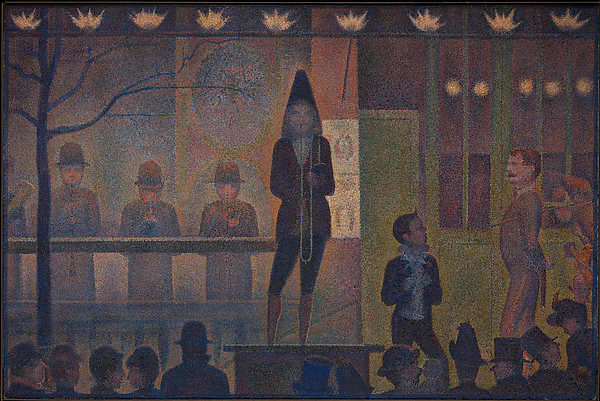
His later work pushed the dots even further, into the flat, artificial glow of the music hall.
Where can you see it?
You can see it at the Art Institute of Chicago, which has been its permanent home for generations and where it draws a steady crowd of its own. Reproductions can't do it justice: the dots dissolve into shimmer only at the right distance, and the sheer scale is part of the experience. If you're planning a trip, our guide to the museum's can't-miss works will point you toward it and a few neighbors.
Seurat died at just 31, only a few years after finishing it — a short life behind a painting that seems to hold its breath forever. Sit with the Grande Jatte a while and notice how long it takes for the crowd to feel lonely.
Sources
Discussion
Be the first to share your thoughts.
Sign in to join the discussion.