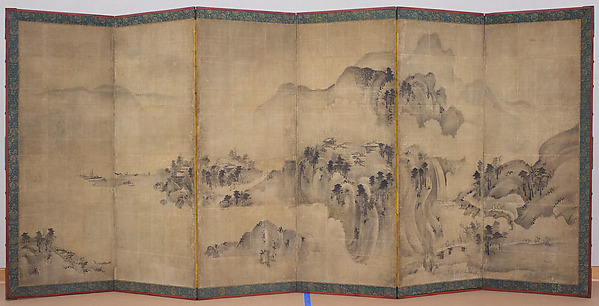
Landscape of the Four Seasons
SEE IT IN PERSON
Not currently on view
In the collection of Art Institute of Chicago, Chicago · as of July 2026
Discussion
FROM THE ART INSTITUTE OF CHICAGO’S CATALOG
Sesson Shukei was a Zen Buddhist monk and painter who achieved his idiosyncratic painterly style during an itinerant career in eastern Japan, seemingly without ever traveling to Kyoto, Japan’s cultural and political capital at the time. Sesson’s dream-like Chinese landscape expands before our eyes in understandable spatial depth, an effect that is enhanced by the folds of the screen. Reading the composition in the same manner as the Japanese language, from right to left, the seasons flow from the first red plum blossoms of the year, depicted on the right side of the right screen (top), all the way across to the snow-covered mountains on the far left side of the left screen (bottom). A mountain temple on the right and a village on the left enclose an inlet upon which boats come and go. People bustle about in activity, geologically impossible rock formations twist and turn, and water splashes out from the bottom of a waterfall like reaching fingers. For adherents of Zen Buddhism, a sect with origins in China, idealized landscapes described a world akin to paradise, in which intellectual and religious activities could be pursued unhindered and the cycle of the seasons symbolized the h
Be the first to share your thoughts.
Sign in to join the discussion.
More by Sesson Shukei

More like this
 Sesson Shūkei
 Soga Shohaku — Mount Fuji and the Miho Pine Forest
 Soga Shohaku — Mount Fuji and the Miho Pine Forest
 Tosa Mitsuoki — Bamboo and Fences
 Yamamoto Baiitsu — 山本梅逸筆 四季山水図|Landscapes of the Four Season
 Kano Yasunobu — Monkey Trainers and Scenes of Chinese Life (
 Andō Baiho
 Sesshū Tōyō (Japanese, 1420–1506) — Birds and Flowers in a L
 Kō Sūkoku (Japanese, 1730–1804) — Spring and Autumn Farming
 Sino-Portuguese, Probably Macau — Folding Screen (Biombo)