FROM THE CLEVELAND MUSEUM OF ART’S CATALOG
Yang Yisun transcribed this ancient text on six narrow scrolls, starting at the top right and ending at the bottom left. Yang emphasizes the text’s historic nature by using the seal script style found on stone steles and bronze vessels. On Happiness features reflections of a scholar on a leisurely life in the countryside, composed by Han dynasty official Zhongchang Tong, who died the year the Han dynasty collapsed (AD 220). The idyllic life described in the text may be an evocation of the past in a time of national crisis. A decade before Yang wrote these scrolls, Anglo-French forces had looted and burned the Summer Palace in Beijing. At the same time, the domestic Taiping rebellion (1850–64), led by a religious fanatic to overthrow the Qing government, had devastated Yang’s homeland, the Jiangnan region, with an estimated 20 million lives lost.
Source ↗︎
Be the first to share your thoughts.
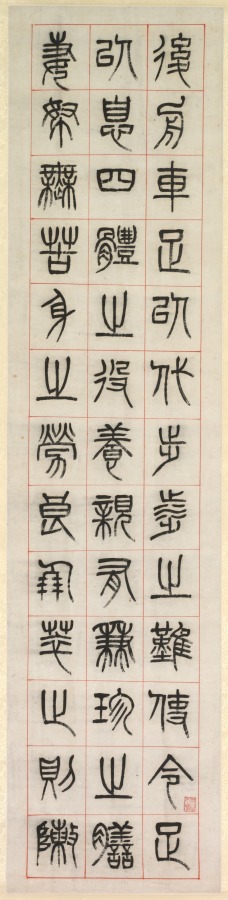 On Happiness, Calligraphy in Seal Script Style (zhuanshu)
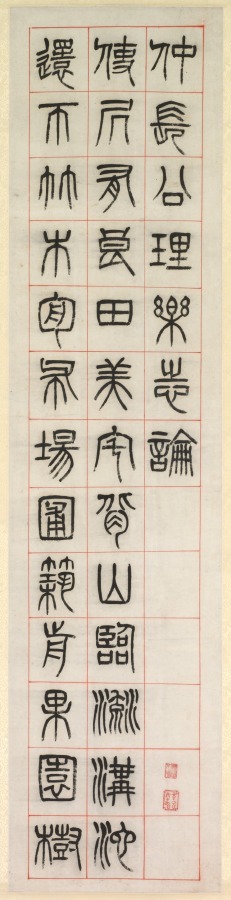 On Happiness, Calligraphy in Seal Script Style (zhuanshu)
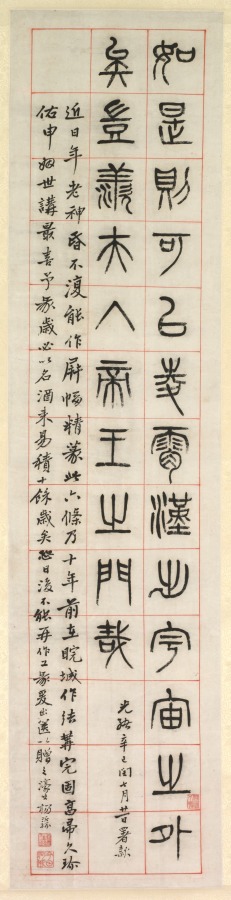 On Happiness, Calligraphy in Seal Script Style (zhuanshu)
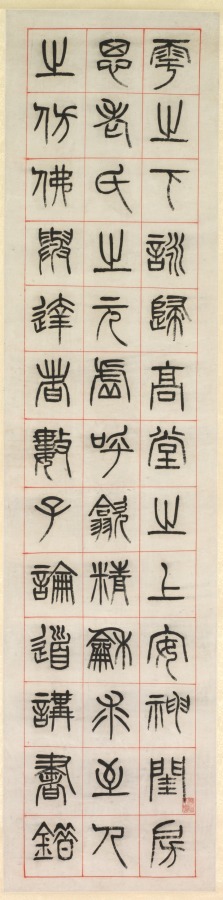 On Happiness, Calligraphy in Seal Script Style (zhuanshu)
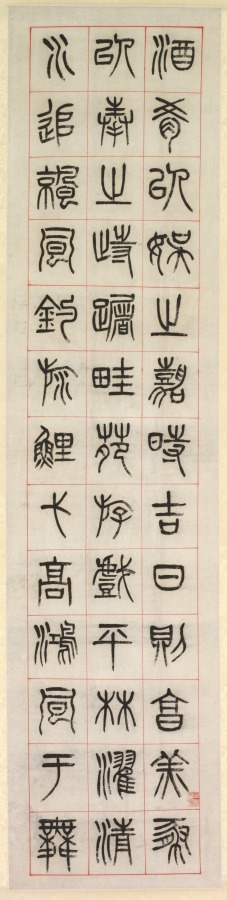 On Happiness, Calligraphy in Seal Script Style (zhuanshu)
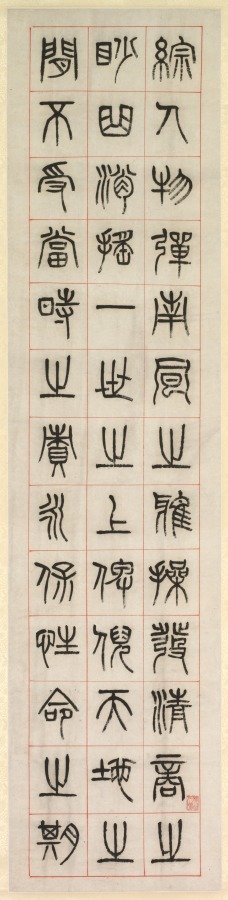 On Happiness, Calligraphy in Seal Script Style (zhuanshu)