Mirror View, Yosemite Valley, Mariposa County, Cal.
SEE IT IN PERSON
Not currently on view
In the collection of Art Institute of Chicago, Chicago · as of July 2026
Discussion
FROM THE ART INSTITUTE OF CHICAGO’S CATALOG
Stereographs were made by taking two photographs of the same scene with lenses about two and a half inches apart to match the distance between human eyes. Viewed through a stereoscope, the two images combine to give the illusion of depth. Enormously popular as items for both entertainment and education, millions of stereographs were produced from 1850 to 1930, documenting disasters, expeditions, monuments, and exotic locations. Carleton Watkins first photographed Yosemite in 1861, and his views of the valley portrayed this newly seen American West as pristine and majestic. In addition to his “mammoth-plate” camera that produced 18 x 22–inch negatives, Watkins had made approximately 1,400 stereo negatives by the end of 1866, which were packaged in series and sold singly or by the dozen to tourists and casual customers. In this image, Watkins’s common use of mirroring as a pictorial device is enhanced by the startling three-dimensional effect of the stereo view.
Be the first to share your thoughts.
Sign in to join the discussion.
More by Carleton Watkins
 Untitled (Warehouse on Wharf)
 First View of Yosemite Valley from the Mariposa Trail
 Untitled (Mining Town)
 Untitled (Miners and Log Cabin)
 San Francisco Bay
 The Vernal Fall, 300 ft., Yosemite, from the series "Watkins
 First View of the Yosemite Valley from the Mariposa Trail
 Section of the Grizzly Giant with Galen Clark, Mariposa Grov
More like this
 Timothy O'Sullivan — Apache Lake, Summit of Sierra Blanca Mo
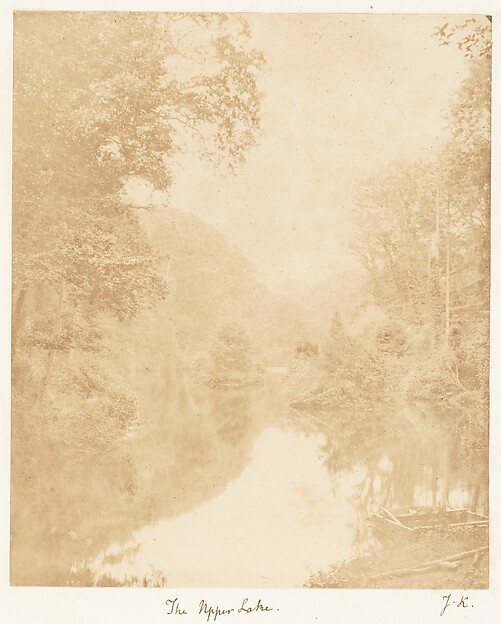 James Knight — The Upper Lake
 Charles Marville — Untitled, from the series "Bois de Boulog
 G. F. Gates — Artist's Dream, No. 18 from the series "Stereo
 London Stereoscopic and Photographic Company — Stereo Kodak
 Andrew Joseph Russell — Mirror Lake A, No. 35 from the serie
 Constant Famin — Etang et Fermiere (Pool and Farmer's Wife)
![[Tree and Brush in Creek Scene]](https://images.metmuseum.org/CRDImages/ph/web-large/DP143492.jpg) John Dillwyn Llewelyn — [Tree and Brush in Creek Scene]
John Dillwyn Llewelyn — [Tree and Brush in Creek Scene] Henry Hamilton Bennett — Reflection in Blazier Creek, No. 9
  Charles Marville — Untitled, from the series "Bois de Boulog
 Timothy O'Sullivan — Cooley's Ranch, 10 miles east of Camp A
 Charles Marville — Untitled, from the series "Bois de Boulog