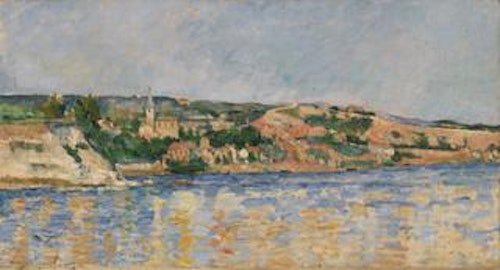
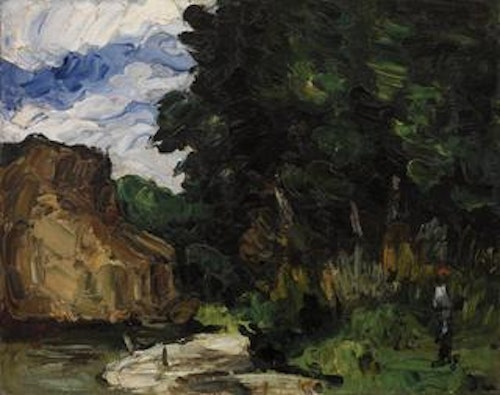
In the collection of Barnes Foundation, Philadelphia — check current display status with the museum.
FROM THE BARNES FOUNDATION’S CATALOG
Cezanne's friend Émile Zola, a writer, defined a work of art as "a corner of nature seen through a temperament." A Table Corner witnesses Cézanne's intent to paint his immediate sensations of things, rather than their objective reality. The artist allegedly said that he saw the planes of objects overlapping; here, he achieved this effect partly by rhythmically arranging warm- and cool-colored fruits on the tabletop and a white plate. Note how the artist demarcates the slashed pomegranate from its neighboring fruits by a seemingly solid shadow; the folding screen reiterates the table's corner while also disturbing the spatial relationships between itself, the table, and the wall.
Be the first to share your thoughts.
Sign in to join the discussion.
 Paul Cezanne — The Peppermint Bottle
 Paul Cezanne — Still Life with Apples and Peaches
 Paul Gauguin — Still Life
 Paul Cezanne — Still Life with Milk Jug and Fruit
 Paul Gauguin — Fruits and Knife
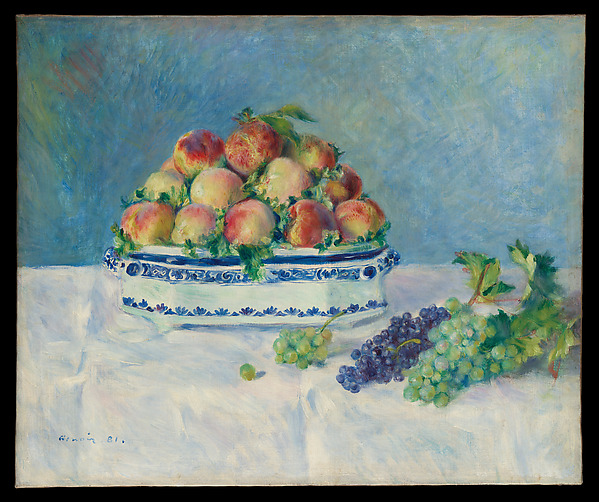 Auguste Renoir — Still Life with Peaches and Grapes
 Pierre-Auguste Renoir — POIRES ET POMMES
 Claude Monet — Still Life with a Honeydew Melon
 Gustave Caillebotte — L'Assiette de pêches
 Paula Modersohn-Becker
 Pierre-Auguste Renoir — Still Life with Peaches and Grapes
 Pierre-Auguste Renoir — Pommes et poires