Hubert Robert

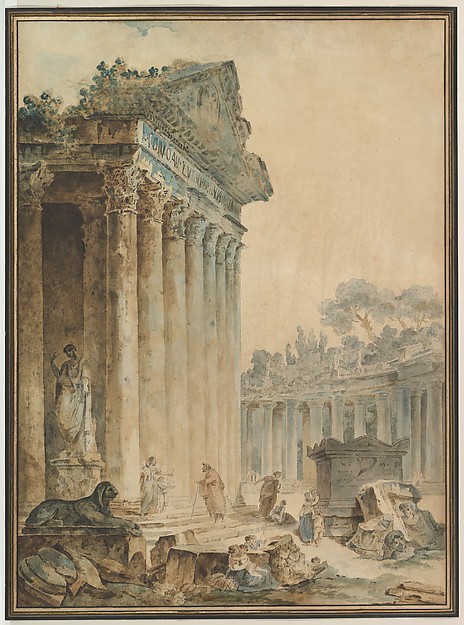
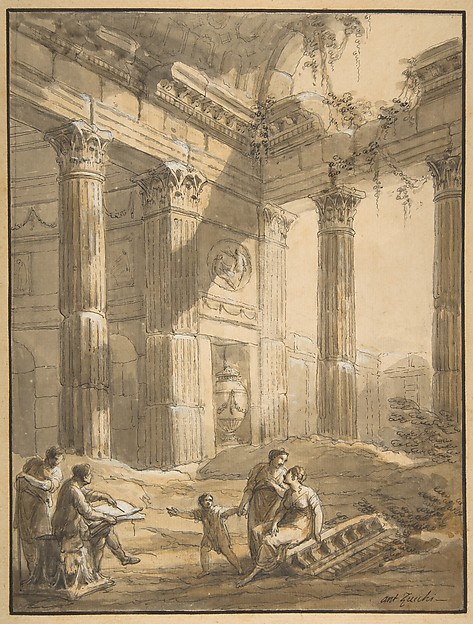
Roman Ruins, Villa Pamfili

1774
Pen and black ink and watercolor with black chalk underdrawing and heightened with white gouache on cream laid paper

SEE IT IN PERSON

Not currently on view

In the collection of Cleveland Museum of Art, Cleveland · as of July 2026

View at clevelandart.orgPlan a visit ↗

Discussion

FROM THE CLEVELAND MUSEUM OF ART’S CATALOG

While living in Italy, Robert developed a fondness for classical architecture, making countless drawings that served as the basis for paintings and prints for decades after he returned to Paris. Denis Diderot (1713–1784), a French philosopher and art critic, nicknamed the artist “Robert of Ruins” due to Robert’s enduring interest in the subject. A quaint commentary on the passage of time, this drawing portrays the activities of contemporary life among the weathered remains of an ancient Roman building. Despite the traditional title of the drawing, there is no evidence that such ruins ever existed at the Villa Pamphili. The towering columns supporting a decorative frieze may instead derive from the Roman Forum’s Temple of Saturn.

Source ↗

Be the first to share your thoughts.

Sign in to join the discussion.

Community guidelines

More by Hubert Robert

The Bathing PoolThe Bathing PoolThe Mouth of a CaveThe Mouth of a CaveThe DanceThe DanceBridge over a CascadeBridge over a CascadeWandering MinstrelsWandering MinstrelsA Colonnade in RuinsA Colonnade in RuinsThe Landing PlaceThe Landing PlaceThe FountainsThe Fountains

More like this

Gardens of the Villa d'Este at TivoliCharles Joseph Natoire — Gardens of the Villa d'Este at TivoView of the So-Called Temple of Concord, from Views of RomeGiovanni Battista Piranesi — View of the So-Called Temple ofArchitectural Capriccio with Roman Monuments and WasherwomenHubert Robert|Hubert Robert — Architectural Capriccio with RCapriccio with an Ancient TempleHubert Robert — Capriccio with an Ancient TempleFigures in Classical RuinsGiovanni Paolo Panini — Figures in Classical RuinsA Temple in a Courtyard (Pool of Bethesda)Adam Elsheimer — A Temple in a Courtyard (Pool of Bethesda)Views of Rome:  Forum of NervaGiovanni Battista Piranesi (Italian, 1720–1778) — Views of RViews of Rome:  The Arch or TitusGiovanni Battista Piranesi (Italian, 1720–1778) — Views of RThe Portico with the Lantern, from VeduteCanaletto — The Portico with the Lantern, from VeduteThe columns of the Temple of Antoninus to right, a part of the Campo Vaccino in center and at left, along with various animals and figures, the Palatine ruins in the background, from 'Six large views, four of Rome, and two of the Roman countryside' (Six grandes vues, dont quatre de Rome et deux de la Campagne romaine)Stefano della Bella — The columns of the Temple of AntoninusVisitors Inspecting Classical RuinsLouis Jean Desprez — Visitors Inspecting Classical RuinsThe columns of the Temple of Antoninus to right, a part of the Campo Vaccino in center and at left, along with various animals and figures, the Palatine ruins in the background, from 'Six large views, four of Rome, and two of the Roman countryside' (Six grandes vues, dont quatre de Rome et deux de la Campagne romaine)Stefano della Bella — The columns of the Temple of Antoninus