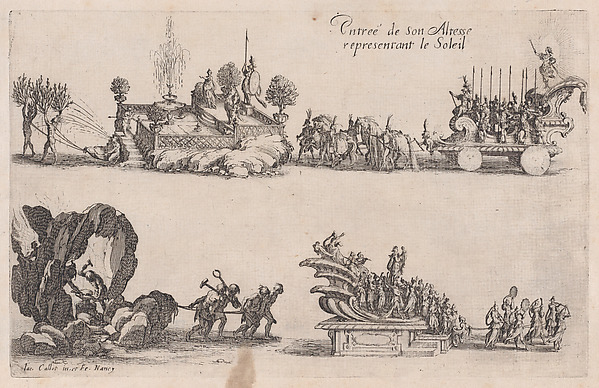
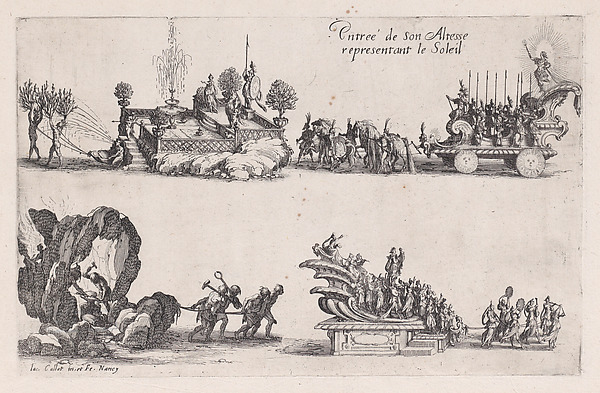
Entry of His Highness, Representing the Sun, from The Combat at the Barrier
1627
Etching in black on ivory laid paper
15.5 × 24.2 cm (6.1 × 9.5 in)
SEE IT IN PERSON
Not currently on view
In the collection of Art Institute of Chicago, Chicago · as of July 2026
Discussion
FROM THE ART INSTITUTE OF CHICAGO’S CATALOG
Charles IV, Duke of Lorraine, appears at the upper right at the end of his grand entry parade, wreathed in the glow of the sun, for he portrays the god Apollo. His sumptuous procession begins at the lower right, with a stage of performing musicians drawn by women with cymbals; the forge of the god Vulcan follows, then a formal garden with fountains, pulled by men transforming into trees. Long-maned horses draw the Duke’s resplendent, likely gilded chariot. The face of the sun appears often on the vehicle, even its spinning wheels.
Be the first to share your thoughts.
Sign in to join the discussion.
More by Jacques Callot
 Sketches for the Balli di Sfessania (recto) Sketches of Danc
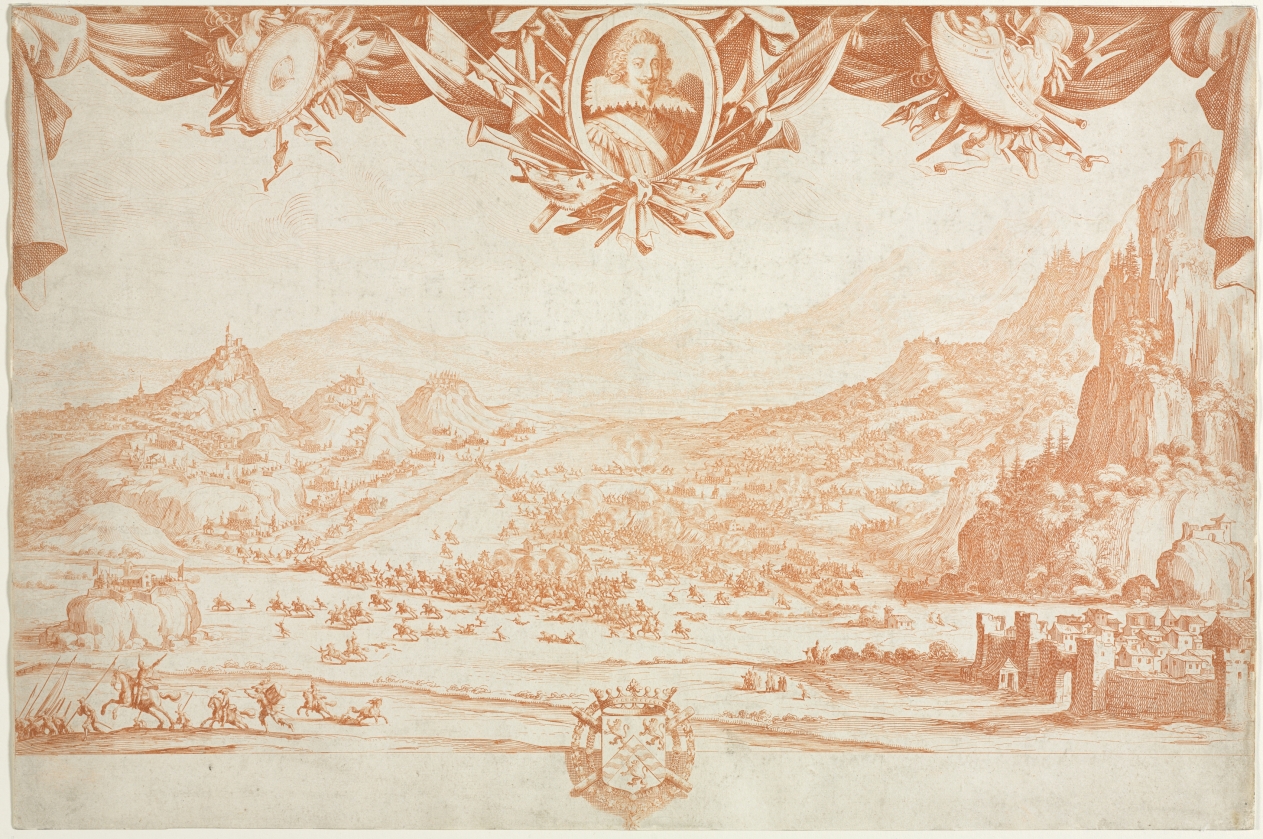 The Combat of Avigliamo
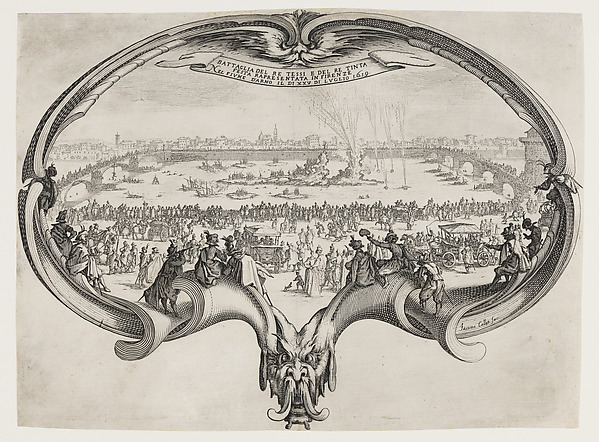 The Feast of Saint James, Florence, July 25, 1619
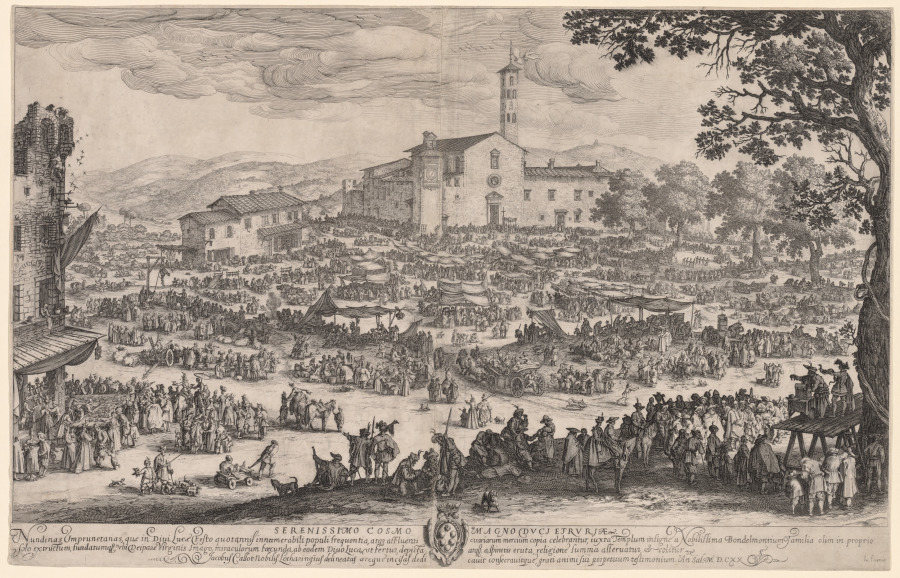 The Fair at Impruneta
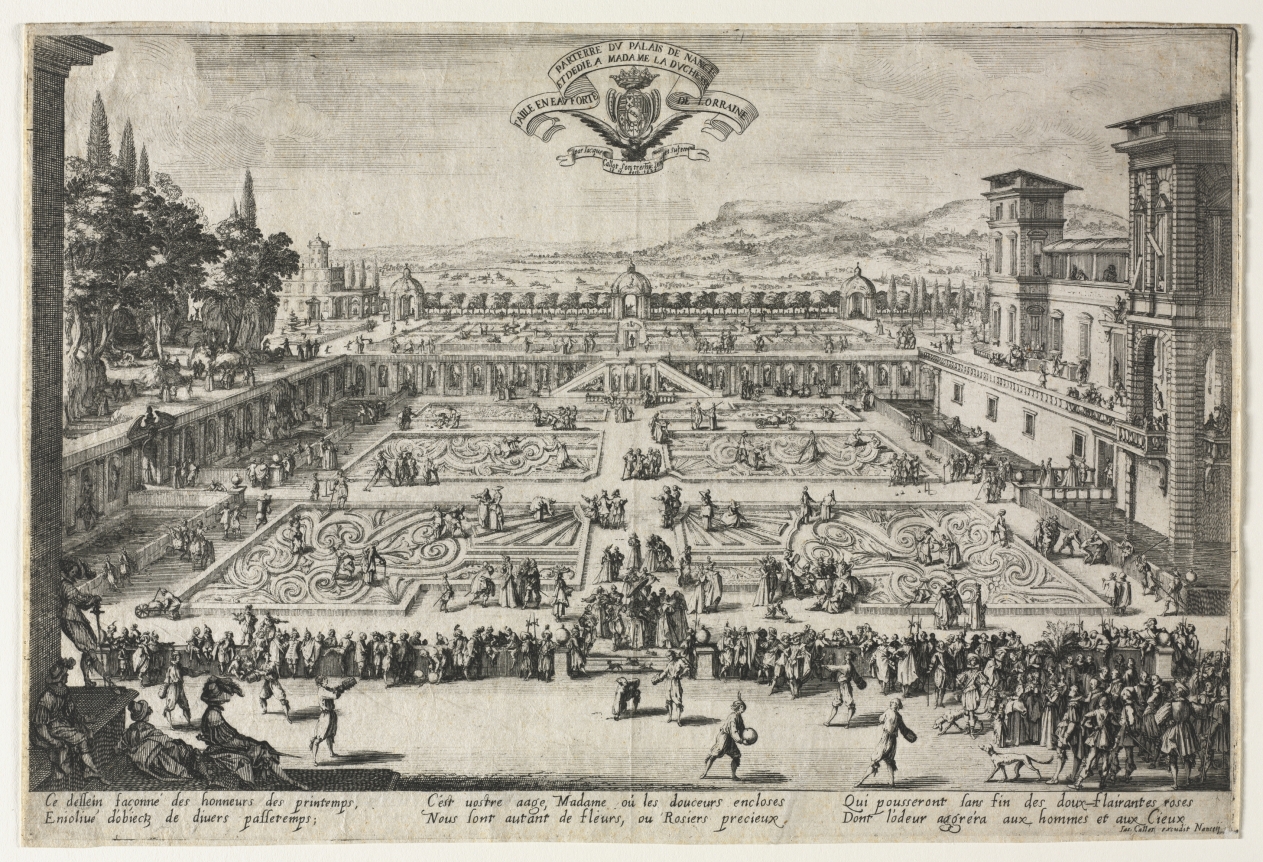 The Palace Gardens at Nancy
 Les Miseres Et Les Mal-Heurs De La Guerre...Israel
 The Temptation of Saint Anthony (second version)
 Franca Trippa - Fritellino, from the Balli di Sfessania
More like this
 Jacques Callot|Henri Humbert — Entrée du duc Charles IV (Ent
 Jacques Callot|Henri Humbert — Entrée du duc Charles IV (Ent
 Stefano della Bella — Plate Four, from Entrance of the Ambas
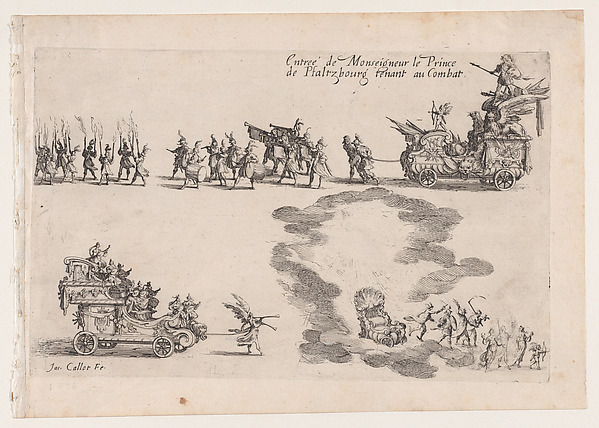 Jacques Callot|Henri Humbert — Entrée du Prince de Pfalzbour
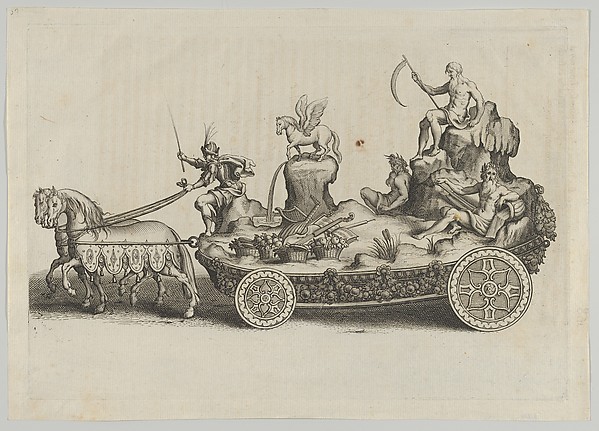 Melchior Tavernier|Pierre Firens I|Abraham Bosse|Jean-Baptis
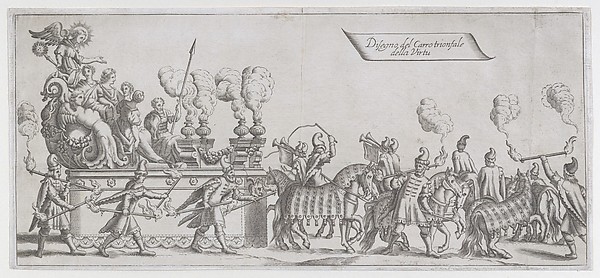 Anonymous, Italian, 17th century|Nicolò Nelli — Design of th
 Jacques Callot|Istituto Centrale per la Grafica — Reprint of
 Anonymous, Dutch, 17th century|Jacob van Meurs — The Court o
 Anonymous, German, 17th century — Triumphal Entry of King
 Stefano della Bella — Plate Three, from Entrance of the Amba
 Jacques Callot|Anonymous — Copy of Les Bohémiens en Marche:
  Jean Baptiste Marie Pierre — The Chinese Mascarade