Quiet Life in a Wooded Glen 林麓幽居圖
SEE IT IN PERSON
Not currently on view
In the collection of Art Institute of Chicago, Chicago · as of July 2026
Discussion
FROM THE ART INSTITUTE OF CHICAGO’S CATALOG
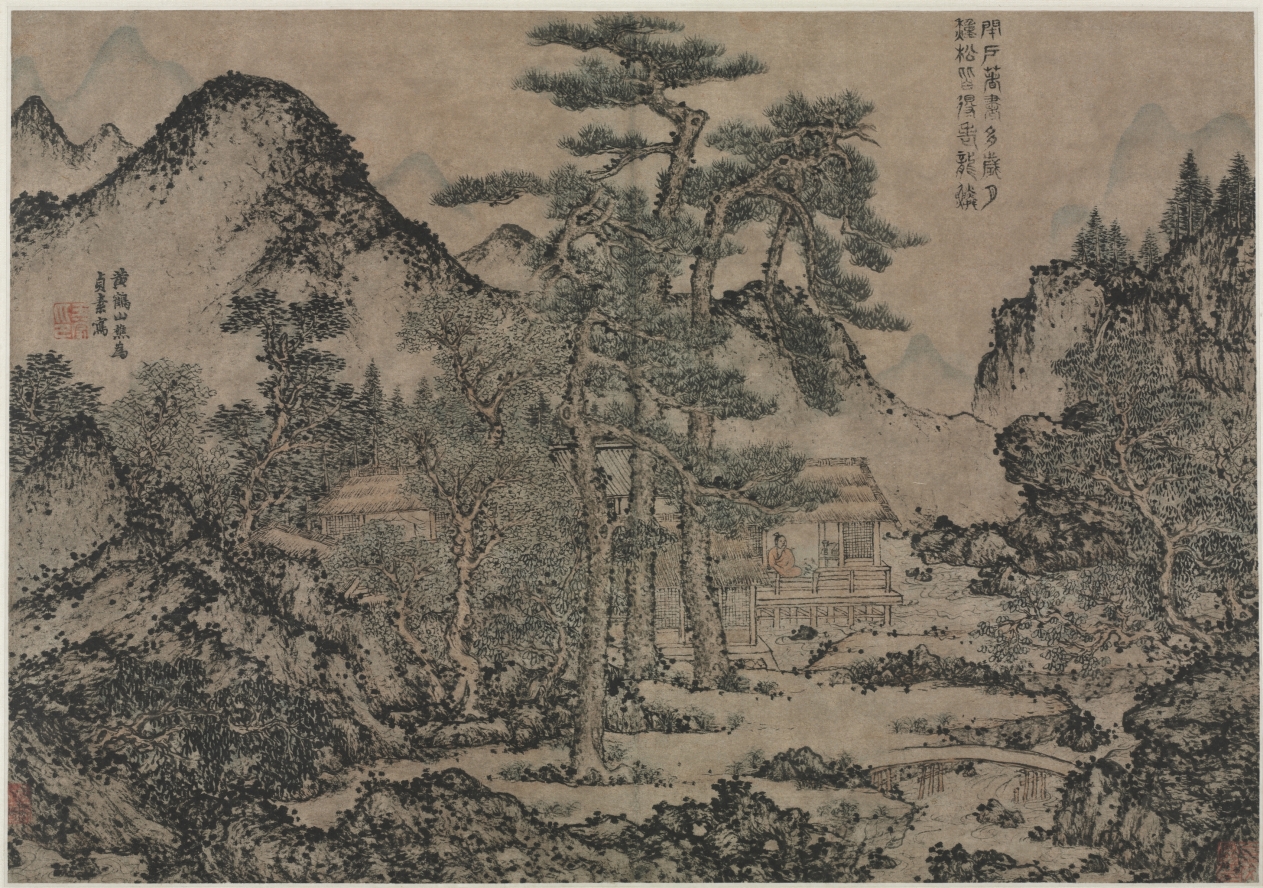
This modest cottage nestled at the foot of towering mountains presents a quintessential image of academic retreat from the “dusty” world of material concerns and political instabilities. Its cultured occupant kneels on a platform and plays the zither ( qin ); a book lies open before him and young servants wait attentively nearby. The luxuriant setting of layered peaks and intertwined trees, as well as the dry, charcoal- like treatment of fibrous and dotted boulders, is imbued with a textural richness. This style is closely associated with Wang Meng, the last of the “Four Great Masters” of the Yuan dynasty. Such a complex, kinetic composition reflects this artist's distinctive contribution to the literati's new use of painting as a vehicle for intellectual and emotional self-expression. This concept was largely kindled by social and political upheavals that accompanied the 14th-century Mongol conquest of China and the establishment of the Yuan dynasty. Wang Meng, who had served the Mongol government as a legal scribe, retired to a mountain hermitage in the turbulent final decades of Yuan rule. He may have executed this painting as a metaphorical self-portrait.
Be the first to share your thoughts.
Sign in to join the discussion.
More by Wang Meng
More like this
 Wang Shimin — Landscape after Wang Meng
 Wen Zhengming (Chinese, 1470–1559) — Playing the Qin in a Se
 Urakami (Uragami) Gyokudō 浦上玉堂
 Shi Rui (Chinese, c. 1400-c. 1470) — The Haven of the Peach-
 Bada Shanren (Chinese, 1626–1705) — Landscape after Guo Zhon
 Fa Ruozhen — 清 法若真 雲山圖軸|Cloudy Mountains
 Ike Taiga
 Zhang Shanghe — 清 張上龢 山水 軸|Landscape
 Hine Taizan 日根對山 — 「夏山深翠」(Kazan shinsui) |“The Deep Green of
 Wang Hui (Chinese, 1632–1717) — Landscape
 Gion Nankai (Japanese, 1677–1751) — Landscape
 Xu Ben (Chinese, 1335–1380) — Streams and Mountains