Retable and Frontal of the Life of Christ and the Virgin
SEE IT IN PERSON
● On view now — Gallery 236
Art Institute of Chicago, Chicago · verified July 2026
Discussion
FROM THE ART INSTITUTE OF CHICAGO’S CATALOG
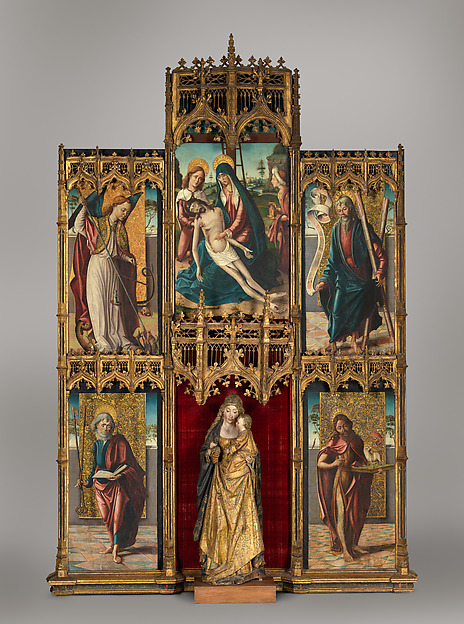
This altarpiece is made up of a retable, which was set up behind the altar table in a Catholic church, and a frontal, which decorated the front of the table itself. The work is a testament to the piety of Pedro López de Ayala, who had the altarpiece made for his family’s funerary chapel in their palace in northern Spain. A major figure in the political and cultural life of late-medieval Spain, Ayala was a courtier, diplomat, and soldier in the service of the kings of Castile, eventually serving as chancellor. The massive altarpiece must have been constructed and painted inside the small chapel. To accomplish this, Ayala called upon local artists, who created a series of scenes that tell the stories of the life of Jesus and his mother, Mary. The composition centers on images of the Crucifixion and of an empty throne that probably once framed a statue of the Virgin and Child. These scenes are not projections of convincing pictorial space. Rather, with their plain backgrounds and framing arcades, they hearken back to earlier architectural decoration and manuscript illumination. The altarpiece was intended to impress through its monumental scale, its narrative clarity, and its costly mat
Be the first to share your thoughts.
Sign in to join the discussion.
More by Spanish



More like this
 Spain, El Burgo de Osma — Altarpiece of the Virgin and Child
 Germany, probably Middle Rhine region — Altar Frontal
 Southern Netherlands, possibly Brussels
After a design by an
Southern Netherlands, possibly Brussels
After a design by an Anonymous, Italian, 15th to 16th century — Tarocchi Cards
 Unknown — Altar Frontal depicting The Resurrection with Four
 Saint Anne with the Virgin and Child
 French Painter, active in Northern France — Leaf from a Pict
 Morata Master — Virgin and Child Enthroned with Scenes from
  English — Susanna and the Elders
 Bernard van Orley — Justitia (Justice) from Los Honores
 Spain — Panel (Made of Reassembled Fragments from Orphrey Ba
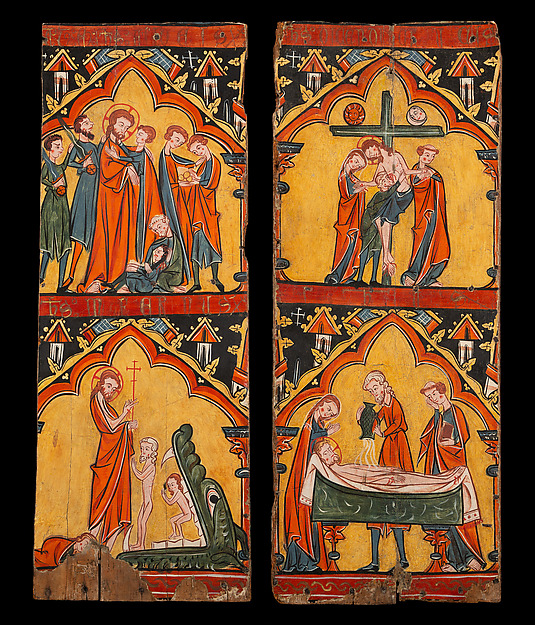 Scenes from the Life of Christ: Arrest of Christ, Christ in