Francisco José de Goya y Lucientes
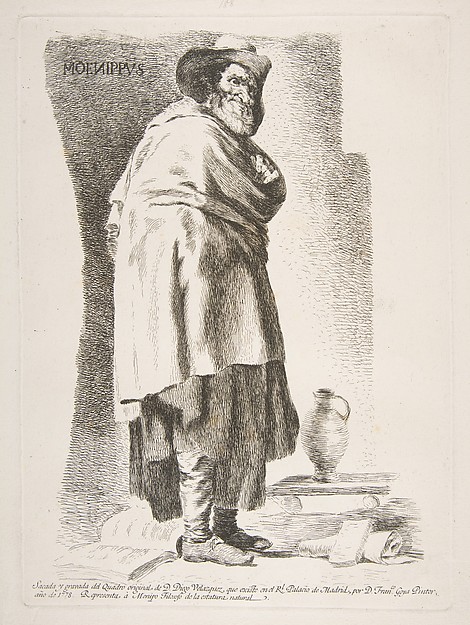
Menippus
SEE IT IN PERSON
Not currently on view
In the collection of Art Institute of Chicago, Chicago · as of July 2026
Discussion
FROM THE ART INSTITUTE OF CHICAGO’S CATALOG
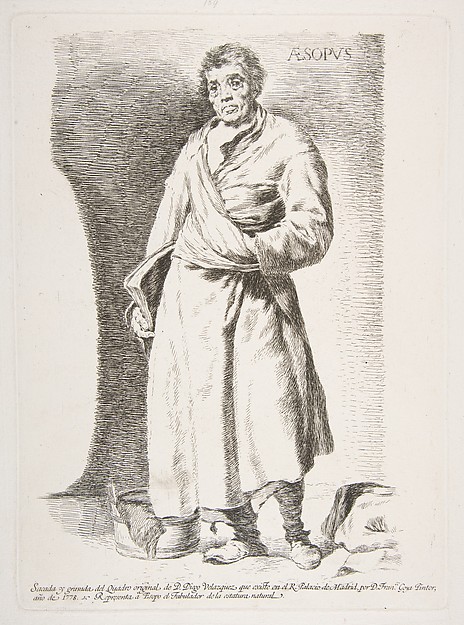
Goya made these two etchings after Velázquez’s portrait pair reenvisioning the ancient writers Menippus (a satirical playwright) and Aesop (a storyteller). Both men were initially slaves, but became free men. They both appear in the paintings holding books or standing near piles of them, although none of their original writings have survived. Like the portraits of the court dwarves, Goya etched these thinkers on a smaller size sheet of paper than Velázquez’s portraits of contemporary nobles (and sold them at half the price).
Be the first to share your thoughts.
Sign in to join the discussion.
More by Francisco José de Goya y Lucientes
 The Hanged Monk
 Friar Pedro Wrests the Gun from El Maragato
 Friar Pedro Shoots El Maragato as His Horse Runs Off
 Portrait of Isidoro Maiquez
 Winter Scene
 Friar Pedro Offers Shoes to El Maragato and Prepares to Push
 Friar Pedro Clubs El Maragato with the Butt of the Gun
 Friar Pedro Binds El Maragato with a Rope
More like this
 Velázquez (Diego Rodríguez de Silva y Velázquez)|Goya (Franc
 Rembrandt (Rembrandt van Rijn) — The Persian
 Velázquez (Diego Rodríguez de Silva y Velázquez)|Goya (Franc
 Joseph Marie Vien, I — Emir Bachi, plate twelve from Caravan
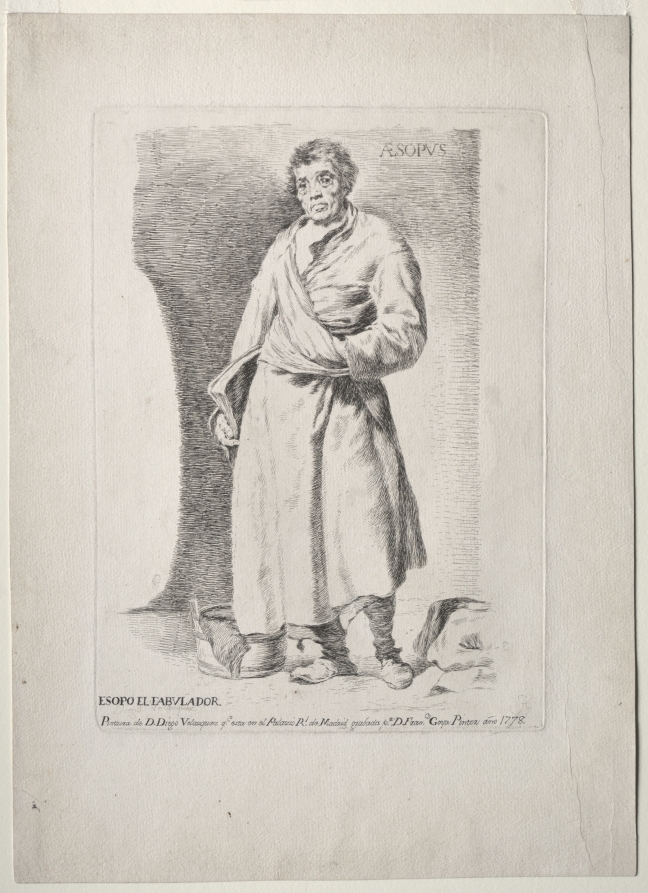 Francisco de Goya (Spanish, 1746–1828) — Aesop
 Giuseppe Longhi (Italian, 1766–1831) — Bust of a Man with a
  James McNeill Whistler — La Mère Gérard
 Rembrandt (Rembrandt van Rijn) — The Persian
 Stefano della Bella — An Old Turk Seated on a Stone
 Giovanni Benedetto Castiglione (Il Grechetto) — Head of an o
 Captain William E. Baillie|Rembrandt (Rembrandt van Rijn) —
  Eugène Delacroix — Mephistopheles Appearing to Faust