Panel from a Sarcophagus Depicting the Abduction of Persephone
SEE IT IN PERSON
● On view now — Gallery 153
Art Institute of Chicago, Chicago · verified July 2026
Discussion
FROM THE ART INSTITUTE OF CHICAGO’S CATALOG
This panel—once the long side of a sarcophagus, or coffin––depicts the abduction of the maiden Persephone by Hades, the Greek god of the underworld. On the left, Demeter, the Greek goddess of the harvest, drives a chariot in search of her daughter. Kneeling in front is Persephone, who looks upward in the moment before her abduction. On the right, Hades flees with the girl thrown over his shoulder. While searching for her daughter, Demeter stopped cultivating the land, and a great famine ensued. The supreme god Zeus intervened, commanding Hades to release Persephone so that Demeter might restore fertility to the earth. Before doing so, Hades tricked Persephone into eating pomegranate seeds, which required that she return to the underworld for part of every year. The theme of death and regeneration is central to this myth. In the Greek and Roman worlds, it explained the changing seasons and the agricultural cycle. When Persephone descended to the underworld, the earth lay fallow. When she returned, abundance was restored. The myth was also considered appropriate for the decoration of a sarcophagus: to be taken by Hades was a popular metaphor for death itself.
Be the first to share your thoughts.
Sign in to join the discussion.
More by Ancient Roman


More like this
 Pakistan
Khyber Pakhtunkhwa Province, ancient region of Gand
Pakistan
Khyber Pakhtunkhwa Province, ancient region of Gand Gerard van Obstal — The Triumph of Silenus
 Gerard de Lairesse — Allegory of the Sciences
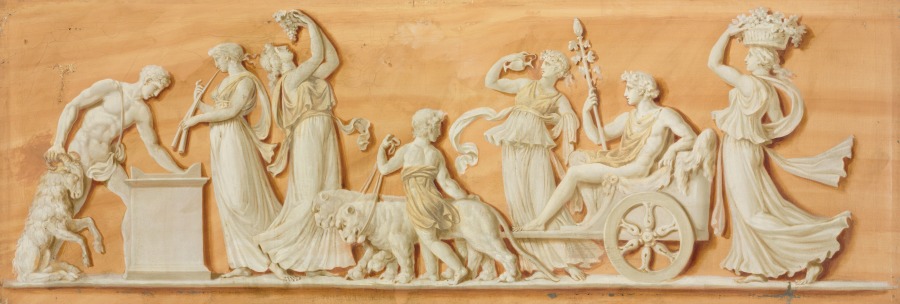 Pierre Rousseau (French, 1751–1829) — Overdoor Painting
 Ancient Greek — Fragment of a Funerary Naiskos (Monument in
  Byzantine — Table Rim Fragments
 Lombard — Capital with Man Fighting Lion (A) and Riding Grif
 Gerard de Lairesse — Allegory of Charity
 Workshop of Massimiliano Soldani-Benzi — Pietà
 Raphael — Design for Funerary Monument to the Marchese Franc
 Unknown artist — Satyr, Faun and Nymphs
 Unknown artist — Bacchus in His Chariot with Attendants