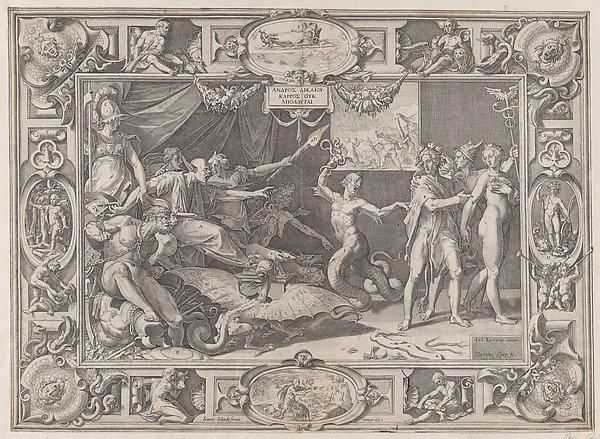
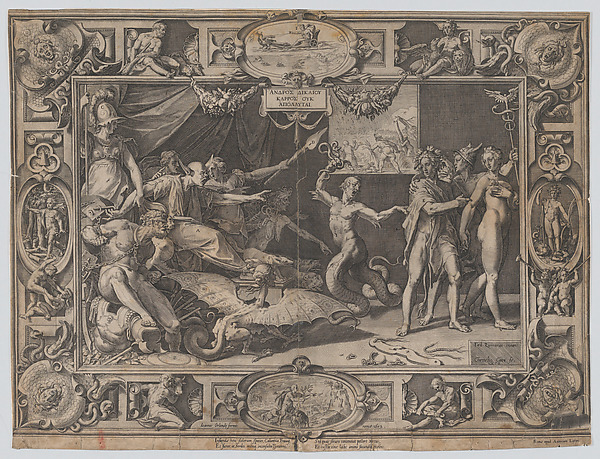
The Calumny of Apelles
SEE IT IN PERSON
Not currently on view
In the collection of Art Institute of Chicago, Chicago · as of July 2026
Discussion
FROM THE ART INSTITUTE OF CHICAGO’S CATALOG
Cornelis Cort’s engraving recreates a lost painting by the ancient Greek artist Apelles, an allegory of slander known only from a detailed description by the ancient historian Lucian. Renaissance artists including Sandro Botticelli, Andrea Mantegna, Albrecht Dürer, and even Pieter Brueghel produced drawings and paintings based on the historian Lucian’s descriptions in homage to various artists of antiquity. Dürer was even called “the Apelles of the North.” Cort’s engraving includes an illusionistic heavily sculptured frame, which highlights prints’ ability to mimic paintings as objects, as well as revive their iconography.
Be the first to share your thoughts.
Sign in to join the discussion.
More by Cornelis Cort




More like this
 Cornelis Cort|Federico Zuccaro (Zuccari)|Giovanni Orlandi —
  Cornelis Cort|Federico Zuccaro (Zuccari)|Giovanni Orlandi —
  Pierre Biard, II — An Allegory of Statuary or Lament of Scul
 Andrea Schiavone (Andrea Meldola)|Jacques Androuet Du Cercea
 Andrea Schiavone (Andrea Meldola)|Battista Angolo del Moro|J
![The Power of Woman [3 Esdras 4:18-19, 22-23, 29-32], from The Four Strongest Powers](https://www.artic.edu/iiif/2/926a29fa-e459-0546-a8db-328c07689e96/full/500,/0/default.jpg) Philips Galle — The Power of Woman [3 Esdras 4:18-19, 22-23,
Philips Galle — The Power of Woman [3 Esdras 4:18-19, 22-23, Claude Gillot — Witches' Sabbath, within a nocturnal landsca
 Agostino dei Musi — Psyche's Father Consulting the Oracle
 Hieronymous Wierix — Vanitas
 Nicolas Beatrizet — The Massacre of the Innocents
 Hendrick Goltzius — The Judgement of Midas
 Marco Dente da Ravenna — The Massacre of the Innocents