Furisode
SEE IT IN PERSON
Not currently on view
In the collection of Art Institute of Chicago, Chicago · as of July 2026
Discussion
FROM THE ART INSTITUTE OF CHICAGO’S CATALOG
This furisode , a long-sleeved garment worn by children and unmarried women on special occasions, belonged to a family whose crest was the tachibana , the flower of the Mandarin orange. Made of rinzu (a soft, lustrous silk), it probably was used as an uchikake (outer coat). The red fabric is woven in a pattern that combines geometric and floral forms. A blossoming plum tree embroidered with gold and white silk thread spreads its branches from hem to shoulder. The carefully embroidered blooming tree shows the influence of Western art on Japanese design. Needlework typical of this period was used to portray illusionistically the contours of the tree trunk. First the edges of the trunk were padded with a heavy thread; then, over this padding, gold-wrapped thread was couched with red silk thread.
Be the first to share your thoughts.
Sign in to join the discussion.
More by Japan


More like this
 Kishi Ganku — Bamboo
 Tosa Mitsuoki — Bamboo and Fences
 Manchu — Man's Jifu (Semiformal Court Robe)
 Tosa Mitsuoki — Bamboo and Fences
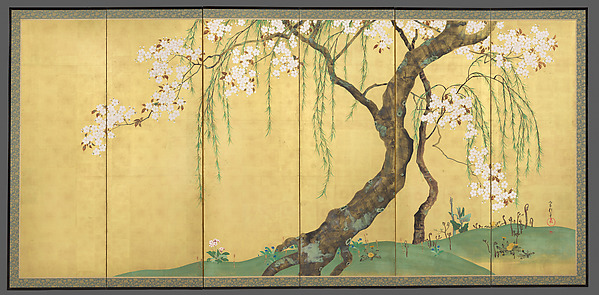 Sakai Hōitsu — 酒井抱一筆 桜楓図屏風|Cherry and Maple Trees
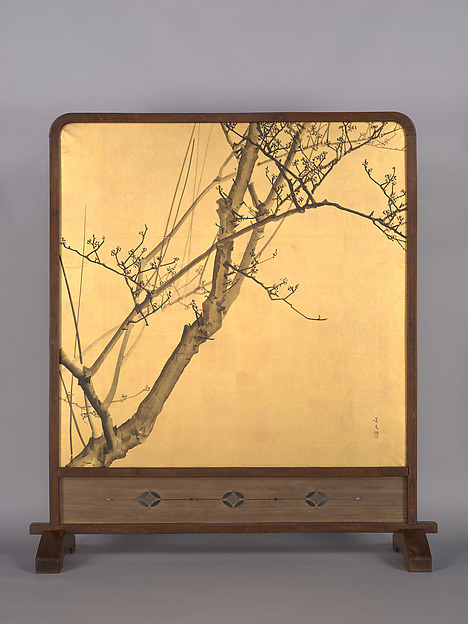 Matsumura Keibun 松村景文|Rai San’yō 頼山陽 — 松村景文筆 頼山陽書 梅図衝立屏風|Plu
 Kishi Ganku — Bamboo
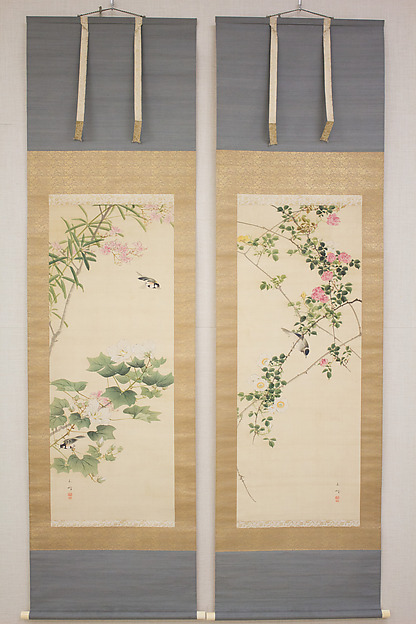 Hasegawa Gyokuho
 China — Picture
 Manchu — Woman's Long Pao (Formal Domestic Robe)
 Kanô Tsunenobu — Landsape with Waterfall