Statue of the Madonna in the Mountains
SEE IT IN PERSON
Not currently on view
In the collection of Art Institute of Chicago, Chicago · as of July 2026
Discussion
FROM THE ART INSTITUTE OF CHICAGO’S CATALOG
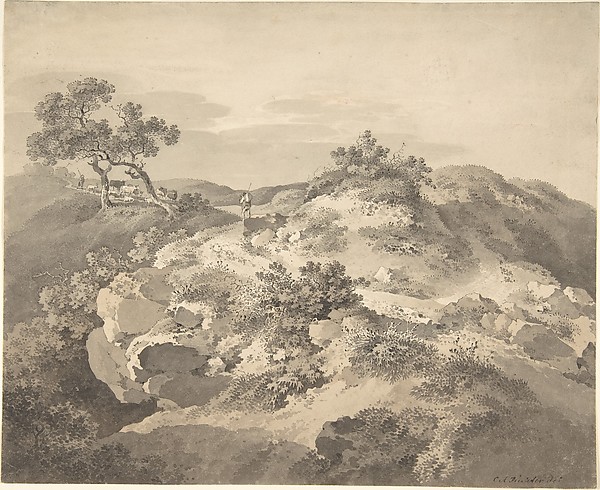
This vast landscape by one of the central figures of German Romanticism dates from Caspar David Friedrich’s early years in Dresden, where he settled after studying in Copenhagen (then considered the artistic center of northern Europe). Subtly graded shades of gray wash evoke the gloomy, overcast days so common in Germany in November, when this image was created. The drawing also conveys, in the artist’s words, “Not only what he sees before him, but also what he sees within him.” In the center of the landscape, atop the highest peak, a tiny pilgrim kneels in prayer at the base of a statue of the Madonna. Nature—with its sheer, blank sky, stark hills, and mute firs—is depicted almost religiously. In this deeply spiritual image, humankind’s experience of nature seems as overwhelming as the unfathomable mystery of our existence. Just as the infinitesimal pilgrim wanders in this faraway, expansive landscape, so too did the artist embark upon his own Romantic quest, a search for meaning in the natural world that reveals the sacred.
Be the first to share your thoughts.
Sign in to join the discussion.
More by Caspar David Friedrich



More like this
 Cornelis van Poelenburch — Landscape
 Alexandre Calame — Forets et Montagnes
 Karl Blechen — The Bode Valley with Rocks and Trees; verso:
  Cornelis van Poelenburch — Landscape
 Johann Christoph Erhard — Bockhart Lake (Der Bockhardsee)
 Jasper F. Cropsey (American, 1823–1900) — A View from Bald M
 Alexandre Calame — Broken Tree in Moutainous Landscape
 Jacob Matham — Bohemian Landscape with Couples and Hunters (
 Jean Jacques de Boissieu (French, 1736–1810) — The Rock of B
 Ernst Fries (German, 1801–1833) — Six Views of Heidelberg Ca
 Carl August Richter — Landscape in Saxony
 Joseph Murray Ince — Town and Castle of Hay