Made in India possibly for the Dutch or Latin American market
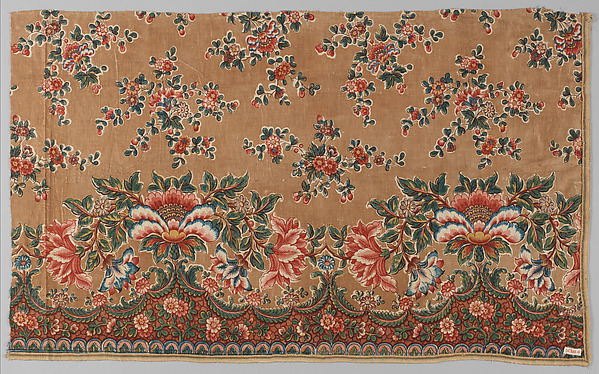
Panel of Chintz for a Woman's Skirt
SEE IT IN PERSON
Not currently on view
In the collection of Art Institute of Chicago, Chicago · as of July 2026
Discussion
FROM THE ART INSTITUTE OF CHICAGO’S CATALOG
Starting in the early 1600s Portuguese traders brought Indian hand-dyed fabrics to Europe, where the Hindi name for them, chint , became chintz . During this same period, Spanish conquests in the Western Hemisphere led to direct trade between Asia and the Americas. This lively patterned chintz displays scrolls and flowers typical of a European design vocabulary as well as tiny scenes of animals and hunters. It exemplifies the creative designs that captivated global consumers and may have been made for the Dutch market, although it could equally have been worn by a woman in New Spain in the 1700s.
Be the first to share your thoughts.
Sign in to join the discussion.
More like this
 India — Cover
 Bannister Hall — Piece
 England — Panel (Possibly a Shawl or bedspread?)
 Piece
Piece France — Fragment (Furnishing Fabric)
 Uzbekistan, Bukhara — Cover
 Fragment
 France, probably Jouy-en-Josas — Fragment
 India — Shawl Fragment
 England — Petticoat Panel
 Italy — Pillow Cover (Incomplete)
 India
Exported for the Sri Lankan market — Length of Chintz
India
Exported for the Sri Lankan market — Length of Chintz