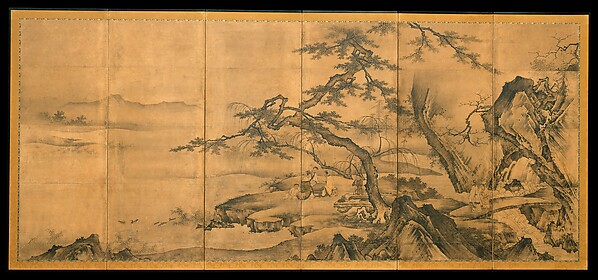
Eight Views of the Xiao and Xiang Rivers
SEE IT IN PERSON
Not currently on view
In the collection of Art Institute of Chicago, Chicago · as of July 2026
Discussion
FROM THE ART INSTITUTE OF CHICAGO’S CATALOG
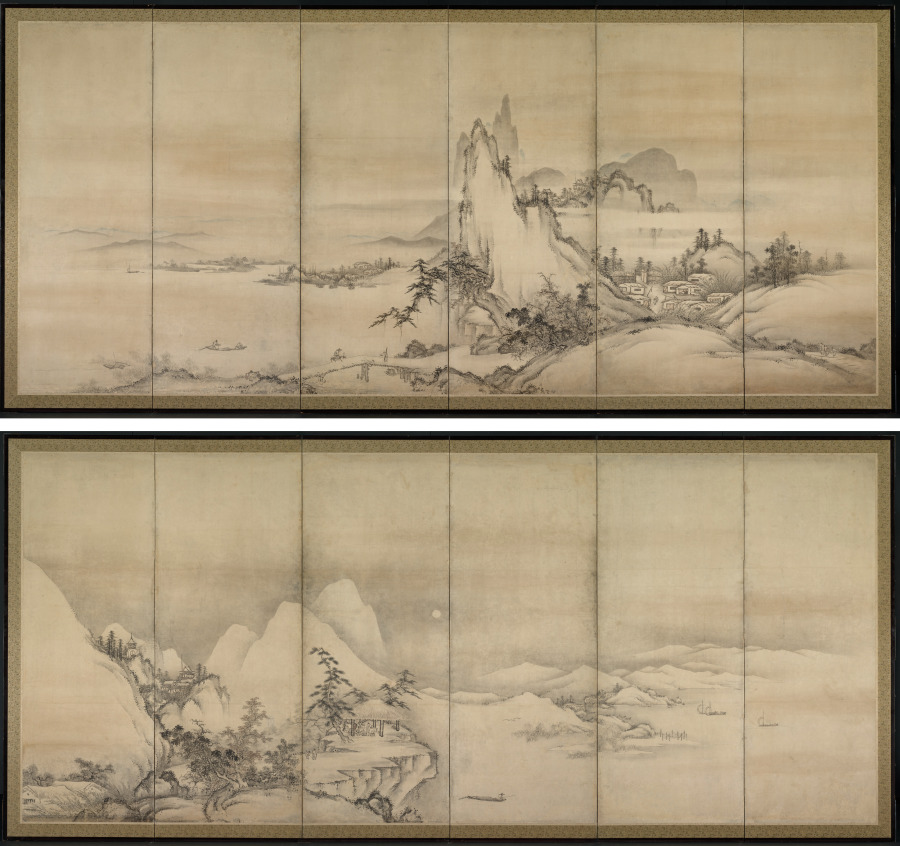
<BIG>瀟湘八景は、11世紀の中国で詩の題材として展開し、1作品に様々な風景の表情を扱うということから、後に日本において水墨画の人気ある主題の1つとなった。この作品は、まさに屏風においての明白な作例である。例えば、右隻の右手には、「洞庭秋月」の月が、山々のはるか彼方に小さな円形で表わされている。同左手には、「瀟湘夜雨」の雨が、墨の縦筋の薄い塗りで表わされ、その中を小舟が一艘、進んでいる。画家は、活発な墨の筆使いに金雲を組み合わせており、中国と日本双方の感性を融合している。 画家の山口雪渓は、京都出身で、中国絵画をはじめ狩野派入門時に学んだが、独立後も本格的に学び続けた。このように前時代の画風に忠実であったことにより、当時の人々に大いに称賛された。</BIG> Eight Views of the Xiao and Xiang Rivers, which first developed as poetic themes in 11th-century China, later became one of the favorite subjects in Japanese ink painting because it allows for so many aspects of a landscape to be treated in one work. This is especially evident in the pair of folding screens seen here. On the far right is “Autumn Moon over Dongting,” exemplified by the small sphere rising just above the mountains in the distance. At the left edge of the same screen, “Night Rain on the Xiao and Xiang” is given expression as streaks of ink wash through which a lone boat makes its way across the river. The artist’s combination of lively ink brushwork with golden clouds fuses both Chinese and Japanese sensibilities. A native of Kyoto, Yamaguchi Sekkei studied Chinese paintings as an apprentice in a Kano-school studio and continue
Be the first to share your thoughts.
Sign in to join the discussion.
More by Sekkei


More like this
 Mitsushige, Tosa — Tale of Genji
 Sesshu — Landscape of the Four Seasons
 Noguchi Shohin — The Gathering at the Orchid Pavilion (front
 Chinese Landscape
 Zhu Derun|Unidentified artist — 明 佚名 朱德潤 怡樂堂圖 卷|Hall of Ha
 Streams and Mountains without End
 Artist Unknown
Japanese — The Tale of Genji
Artist Unknown
Japanese — The Tale of Genji Attributed to Li Gonglin 傳 李公麟 (Chinese, 1049–1106) — The Wa
 Wen Tong
 Yi Sumun (Korean, b. c. 1404) — Landscape of the Four Season
 Kano Motonobu 狩野元信 — 琴棋書画図屏風|The Four Accomplishments
 Maruyama Ōkyo (Japanese, 1733–1795) — Literary Gathering in