The Submersion of Pharaoh's Army in the Red Sea
SEE IT IN PERSON
Not currently on view
In the collection of Art Institute of Chicago, Chicago · as of July 2026
Discussion
FROM THE ART INSTITUTE OF CHICAGO’S CATALOG
The grand scale of Titian’s twelve-sheet woodcut (see 1957.12.1–12) mimics history paintings and large wall hangings. The assembled composition would fit only on a massive wall, a use confirmed by the total lack of early impressions. Only this 1549 state is known, printed from woodblocks studded with wormholes, which appear in the image as tiny white dots. The inscription at lower center of The Submersion describes the Israelites’ persecution under the Egyptian pharaoh and his army’s fate when they followed Moses into the Red Sea. The publisher opportunistically refers to the “great and immortal hand” of Titian in this legend, though the artist was still very much alive.
Be the first to share your thoughts.
Sign in to join the discussion.
More by Titian


More like this
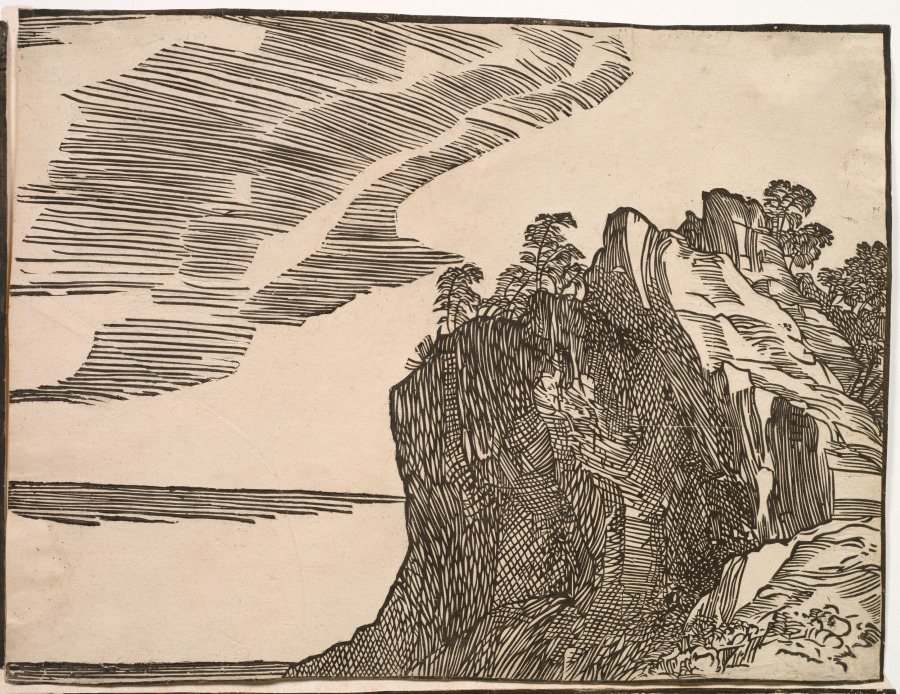 Titian (Italian, c. 1488–1576) — The Submersion of Pharaoh's
 Herman Naijwincx — Rocky Landscape
 Joseph Pennell — Quarry on Pentelicon
 Joseph Pennell — The Holy Trinity of the Castles in the Air
 Herman Naiwincx (Flemish, c. 1624–after 1651) — Le rocher co
 Goya (Francisco de Goya y Lucientes) — Landscape
 Claude Monet — Cliffs and Sea, Sainte-Adresse
 Charles Jacque — La Grande Chaumière Kercassier
 Herman Naiwincx (Flemish, c. 1624–after 1651) — The Rock at
  Donald Shaw MacLaughlan — The Two Pines, Switzerland
 Odilon Redon — Galloping Horseman
 Johan Christian Clausen Dahl — Norwegian Seacoast During a S