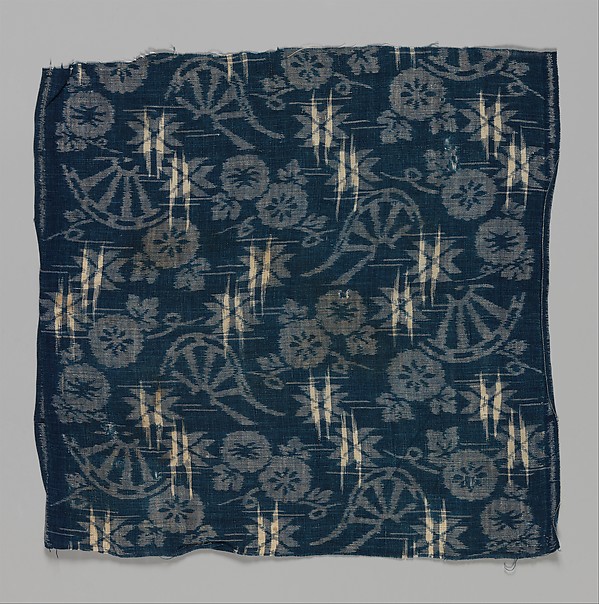
Islamic

Fragment

Mamluk period (1250–1517), late 14th century
Silk, satin weave with plain interlacings of secondary binding warps and patterning wefts
30 × 32 cm (11.8 × 12.6 in)

SEE IT IN PERSON

Not currently on view

In the collection of Art Institute of Chicago, Chicago · as of July 2026

View at artic.eduPlan a visit ↗

Discussion

FROM THE ART INSTITUTE OF CHICAGO’S CATALOG

Textiles held an important place in all Muslim courts, including that of the Mamluks in Egypt and Syria. The appeal of woven fabrics lay in their rich colors, elaborate patterns, and luxury materials such as silk and metal thread. Some woven silks were hung as wall decorations; others were made into robes worn by members of the court or given as official gifts to rulers of neighboring regions.

Source ↗

Be the first to share your thoughts.

Sign in to join the discussion.

Community guidelines

More by Islamic

Pen Box (Qalamdan)Pen Box (Qalamdan)Book with lacquer coversBook with lacquer coversManuscript of Kulliyat (Complete Works) by Sa'di with Lacquered CoverManuscript of Kulliyat (Complete Works) by Sa'di with LacquePen Box with Hunting ScenesPen Box with Hunting ScenesPage from a Copy of the Qur'anPage from a Copy of the Qur'anLayla Visiting Majnun in the Desert, page from a copy of the Khamsa of NizamiLayla Visiting Majnun in the Desert, page from a copy of theBook BindingBook BindingAn Album Page with a Battle Scene from BorzunamaAn Album Page with a Battle Scene from Borzunama

More like this

PanelFrance or Italy — PanelFragmentItaly or Spain — FragmentFragmentItaly — FragmentFragmentItaly — FragmentFragmentManufacture Blanc — FragmentFragmentChancay — FragmentFragmentItaly or Spain — FragmentArtworkFragmentItaly — FragmentFragment (from temple mat)Japan — Fragment (from temple mat)FragmentItaly — FragmentFragmentItaly — Fragment