The Peach Blossom Spring 桃花源圖
SEE IT IN PERSON
Not currently on view
In the collection of Art Institute of Chicago, Chicago · as of July 2026
Discussion
FROM THE ART INSTITUTE OF CHICAGO’S CATALOG
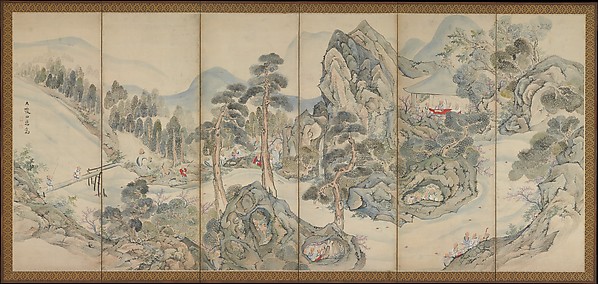
This painting illustrates a fable written by Tao Qian (365-427). From right to left, the scroll depicts a fisherman’s accidental discovery of a peaceful and bountiful farming valley, which is isolated within a mountain cave. The valley’s inhabitants, who had fled from political turmoil six centuries earlier, are unaware of subsequent events in the outside world. Blossoming peach trees, symbolic of immortality, conceal the entrance to their secluded paradise. In depicting this mythic tale, many artists utilized a traditional palette of finely ground mineral pigments-azurite blue and malachite green- to evoke this jewel-like land. Qiu Ying was a renowned master of this “blue-and-green technique. While consistent with Qiu Ying’s precise and decorative style, the soft and restrained brushwork of this scroll suggests that it was painted by one of his close followers.
Be the first to share your thoughts.
Sign in to join the discussion.
More by Qiu Ying


More like this
 Attributed to Li Gonglin 傳 李公麟 (Chinese, 1049–1106) — The Wa
 Streams and Mountains without End
 Unidentified artist — 明 佚名 舊傳燕文貴 溪山行旅圖 卷|Landscape
 Feng Qiyong
 Landscape
 Wang Jianzhang (Chinese, active 1621–1662) — Solitary Colors
 Zhu Derun|Unidentified artist — 明 佚名 朱德潤 怡樂堂圖 卷|Hall of Ha
 Xie Shichen (Chinese, 1487–after 1567) — Returning to the Vi
 Unidentified artist|Guo Xi — 明/清 佚名 舊傳郭煕 關山行旅圖 卷|Tra
 Yang Bangji — 金 傳楊邦基 聘金圖 巻|A Diplomatic Mission to the Jin
 Mi Youren (Chinese, 1072–1151) — Cloudy Mountains
 Ike Taiga — 池大雅筆 蘭亭曲水図屏風 秋社図屏風|Orchid Pavilion Gathering;