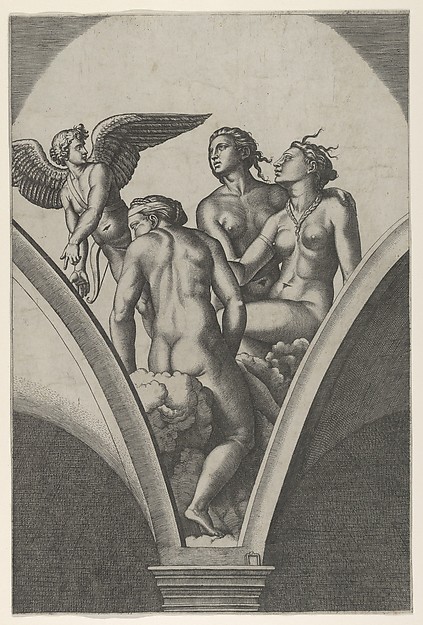
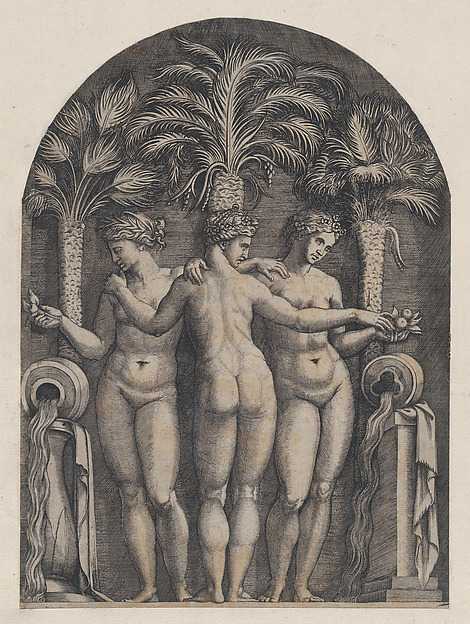
Cupid and the Three Graces
1518/19
Engraving in black on cream laid paper
31 × 20.6 cm (12.2 × 8.1 in)
SEE IT IN PERSON
Not currently on view
In the collection of Art Institute of Chicago, Chicago · as of July 2026
Discussion
FROM THE ART INSTITUTE OF CHICAGO’S CATALOG
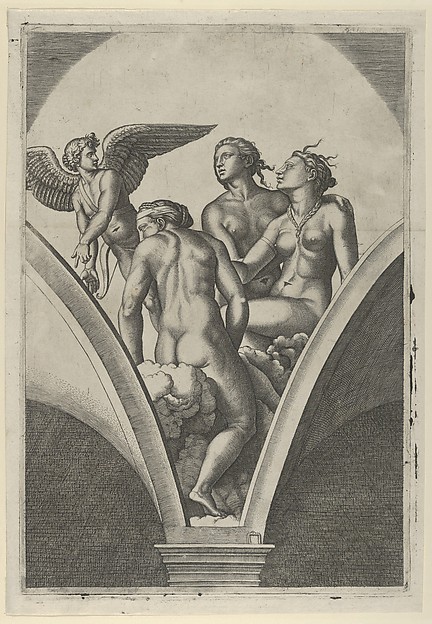
When Raphael painted the frescoes in the garden loggia of Rome’s Villa Farnesina, he faced an unusual pictorial format. Working in the spandrels, he had to account for the nearly triangular spaces created by the arched ceiling. This engraving, a detail of the fresco, clearly demonstrates the structural obstacles of the architecture, as the numerous curved lines represent the vaulted ceiling, trim, and wall.
Be the first to share your thoughts.
Sign in to join the discussion.
More by Marcantonio Raimondi
 Speculum Romanae Magnificentiae: Galba, from The Twelve Caes
 Hercules, grasping Antaeus at the waist with both arms and l
 The Massacre of the Innocents (Without the Fir Tree)
 Apollo on Parnassus, Surrounded by the Muses and Poets
 Speculum Romanae Magnificentiae: Nero, from The Twelve Caesa
 Speculum Romanae Magnificentiae: Vespasian, from The Twelve
  Martyrdom of Saint Lawrence
 Two Fauns Carrying a Child
More like this
 Marcantonio Raimondi|Raphael (Raffaello Sanzio or Santi) — T
 Marcantonio Raimondi|Raphael (Raffaello Sanzio or Santi) — T
 Hans Sebald Beham — Judith and Her Servant
 Hans Sebald Beham — The Judgment of Paris
 School of Marcantonio Raimondi — Venus, Cupid and Pallas
 Giovanni Jacopo Caraglio|Rosso Fiorentino|Master HCB — Venus
 Marcantonio Raimondi|Raphael (Raffaello Sanzio or Santi) — S
 René Boyvin — Hercules and Deianira
 Pierre Biard II — Venus, standing with the three Graces, is
  Giovanni Jacopo Caraglio|Rosso Fiorentino|Master HCB — Venus
 Anonymous, Italian, 16th to early 17th century|Giulio Romano
 Jan Harmensz. Muller — Apotheosis of the Arts