Crouching Woman
SEE IT IN PERSON
Not currently on view
In the collection of Art Institute of Chicago, Chicago · as of July 2026
Discussion
FROM THE ART INSTITUTE OF CHICAGO’S CATALOG
Crouching Woman is one of five pastel studies for Eugène Delacroix’s monumental painting The Death of Sardanapalus (1827; Musée du Louvre, Paris), which helped establish his reputation as the leader of the French Romantic movement. Of the few pastels that Delacroix produced, this is the only group that can be related to a single painting. Inspired by an 1821 play by the English Romantic poet Lord Byron, the canvas dramatically depicts the last king of the Assyrians. Reclining on his bed moments before his own suicide, the king gazes passively at his wives, concubines, and livestock as they are slain by his order to prevent their slaughter by the enemy army that has just defeated them. In this expressive image of one of the concubines, Delacroix convincingly captured the horror of the moment. With a sure, sweeping line, he described the rhythmic, taut posture of a figure recoiling from a blow or the stab of a knife. Although this powerful figure is significantly truncated in the final painting, the pastel provides insight into Delacroix’s creative process, and its sensual drama is representative of the Romantic period.
Be the first to share your thoughts.
Sign in to join the discussion.
More by Eugène Delacroix

More like this
 Jean François Millet — Study: Nude Woman Seen from the Back
  James McNeill Whistler — The Draped Figure, Seated
 James McNeill Whistler — The Draped Figure, Seated
 Auguste Rodin — The Abandoned
 Théophile-Alexandre Pierre Steinlen — Woman Fixing Her Hair,
 James McNeill Whistler — Nude Model, Back View
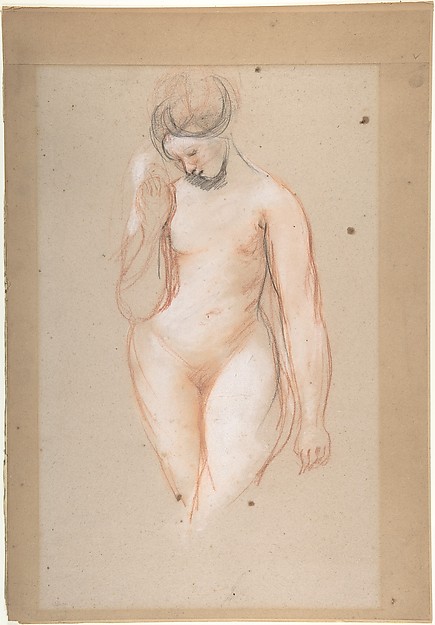 William Etty — Standing Female Nude
 James McNeill Whistler — Draped Figure, Standing
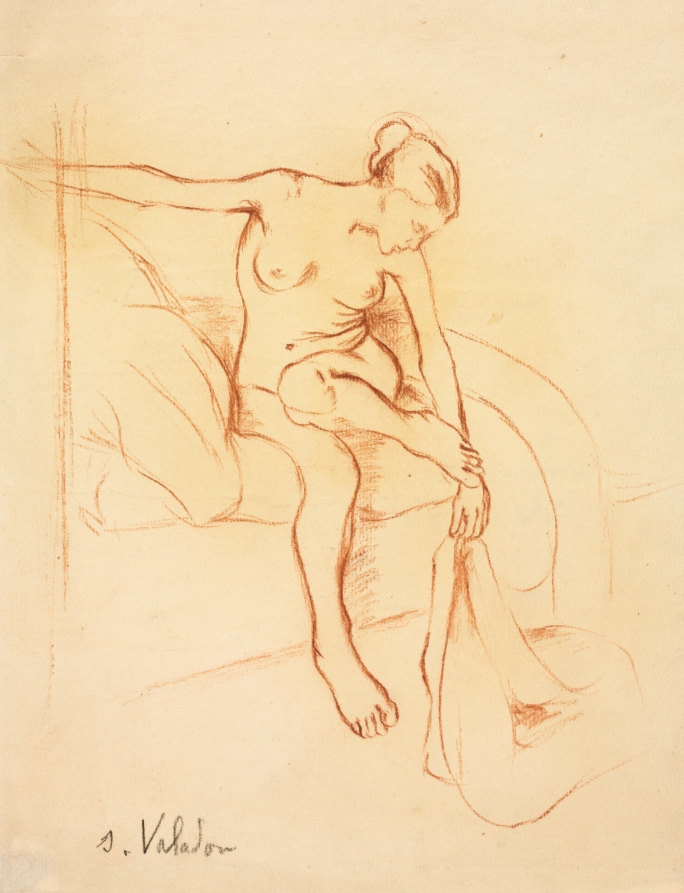 Suzanne Valadon (French, 1865–1938) — Nude Woman Seated on a
 James McNeill Whistler — Girl Lying Down
 James McNeill Whistler — Binding the Hair
 James McNeill Whistler — The Draped Figure, Seated