Two Plant Specimens
SEE IT IN PERSON
Not currently on view
In the collection of Art Institute of Chicago, Chicago · as of July 2026
Discussion
FROM THE ART INSTITUTE OF CHICAGO’S CATALOG
Contained within this haunting and poetic image is the seed of photography: the possibility of creating a negative from which an unlimited number of positives can be made. William Henry Fox Talbot produced this image by placing botanical specimens on sensitized paper and exposing them to light. He made this groundbreaking discovery after his 1833 honeymoon on the shores of Lake Como, in Lombardy, Italy. Frustrated by his inability to draw his Italian surroundings accurately, Talbot recalled the fleeting images of external objects that appeared within a camera lucida (an optical prism that creates a superimposed image on an artist’s drawing surface) and wondered how he could make them “imprint themselves durably, and remain fixed upon the paper.” What resulted, two years later, were the first camera negatives. Unveiled in 1839 and called photogenic drawing, Talbot’s process was perfected two years later into the calotype (from the Greek word kalos , meaning “beautiful”). By the end of his life, Talbot—whose far-ranging interests included mathematics, botany, etymology, and ancient Assyria—had also discovered the basis of halftone printing, obtained twelve patents, and authored seven
Be the first to share your thoughts.
Sign in to join the discussion.
More by William Henry Fox Talbot
![[Botanical Specimen]](https://images.metmuseum.org/CRDImages/ph/web-large/DP339367.jpg)


![[Bookcase at Lacock Abbey]](https://images.metmuseum.org/CRDImages/ph/web-large/DP339368.jpg)

More like this
 Unknown — Untitled
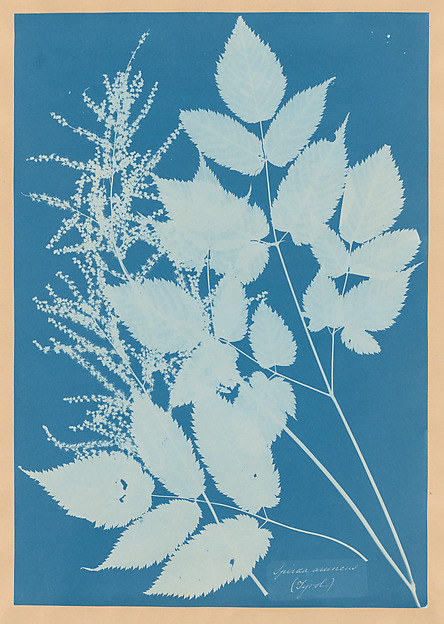 Anna Atkins — Spiraea aruncus (Tyrol)
 Amelia Bergner — Study of Leaves
 Unknown — Untitled (Fern Study), c. 1850, from the Hatton Fe
![[Photogenic Drawing from Leaf]](https://images.metmuseum.org/CRDImages/ph/web-large/DP202293.jpg) Sebastiano Tassinari — [Photogenic Drawing from Leaf]Sebastiano Tassinari — [Photogenic Drawing from Leaf]
Sebastiano Tassinari — [Photogenic Drawing from Leaf]Sebastiano Tassinari — [Photogenic Drawing from Leaf] Antoine Berjon — White Hollyhocks
![[Flower Study, Rose of Sharon]](https://images.metmuseum.org/CRDImages/ph/web-large/DT1158.jpg) Adolphe Braun — [Flower Study, Rose of Sharon]
Adolphe Braun — [Flower Study, Rose of Sharon] Antoine Berjon — Floral Design
 Theodore Roussel — Last Poppies
 Anna Atkins — Confera arcta - the three upper specimens in t
 Hippolyte Bayard — Bouquet de Fleurs