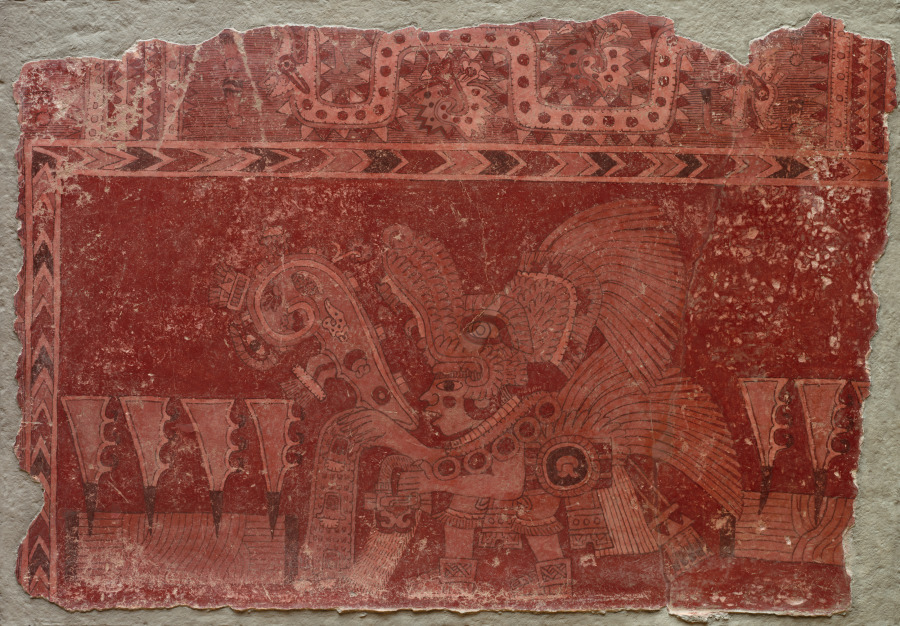
Mural Fragment Depicting a Maguey Bloodletting Ritual
SEE IT IN PERSON
Not currently on view
In the collection of Art Institute of Chicago, Chicago · as of July 2026
Discussion
FROM THE ART INSTITUTE OF CHICAGO’S CATALOG
The ancient Mexican city of Teotihuacan was once the largest city in all of the Americas. The pomp and color of this great city were expressed most distinctively through its monumental architecture. Facades of pyramids and interiors of palaces, temples, and homes were frequently decorated with splendid frescoes. The fragment shown here was part of a cycle painted on the interior walls of an aristocratic palace. It shows a rain priest walking or processing in profile and wearing an elaborate headdress and costume. His speech-scroll, adorned with seashells and plants, indicates that he is praying for water and agricultural prosperity, which were highly valued in his society. Meaning “place of the gods,” Teotihuacan was the largest religious, military, and trading city in the Americas between A.D. 200 and 650, and it was inhabited by over one hundred thousand people at its peak. Designed with colossal pyramids and ritual plazas, the metropolis was built on a cosmologically oriented grid plan that embraced residential and manufacturing districts. This richly symbolic fragment from a Teotihuacan wall fresco depicts a ceremony that took place once every fifty-two years, a “century” in th
Be the first to share your thoughts.
Sign in to join the discussion.
More by Teotihuacan


More like this
 Mural Fragment with Elite Male and Maguey Cactus Leaves
 Coclé — Nose Ornament in the Form of an Long-Nosed Saurian w
 Maya — Stamp
 Ah Maxam — Vessel of the Dancing Lords
 Veracruz, Classic — Fragment of a Hacha
 Maya — Vessel
 China — Pendant
 Tiwanaku — Shield Painted with Abstract Figures
 Veracruz, Classic — Plate with an Image of a Moth
 Aztec (Mexica) — Coronation Stone of Motecuhzoma II (Stone o
 Nasca — Beaker Depicting Rows of Figures with Weapons and Ba
 Moche — Wide-Mouthed Jar with Raised Motif of a Man Attacked