Kesa
1650/1700, Edo period (1615–1868)
Silk and gilt-paper strip; twill weave with secondary binding warp and supplementary patterning wefts
119.4 × 210.5 cm (47 × 82.9 in)
SEE IT IN PERSON
Not currently on view
In the collection of Art Institute of Chicago, Chicago · as of July 2026
Discussion
FROM THE ART INSTITUTE OF CHICAGO’S CATALOG
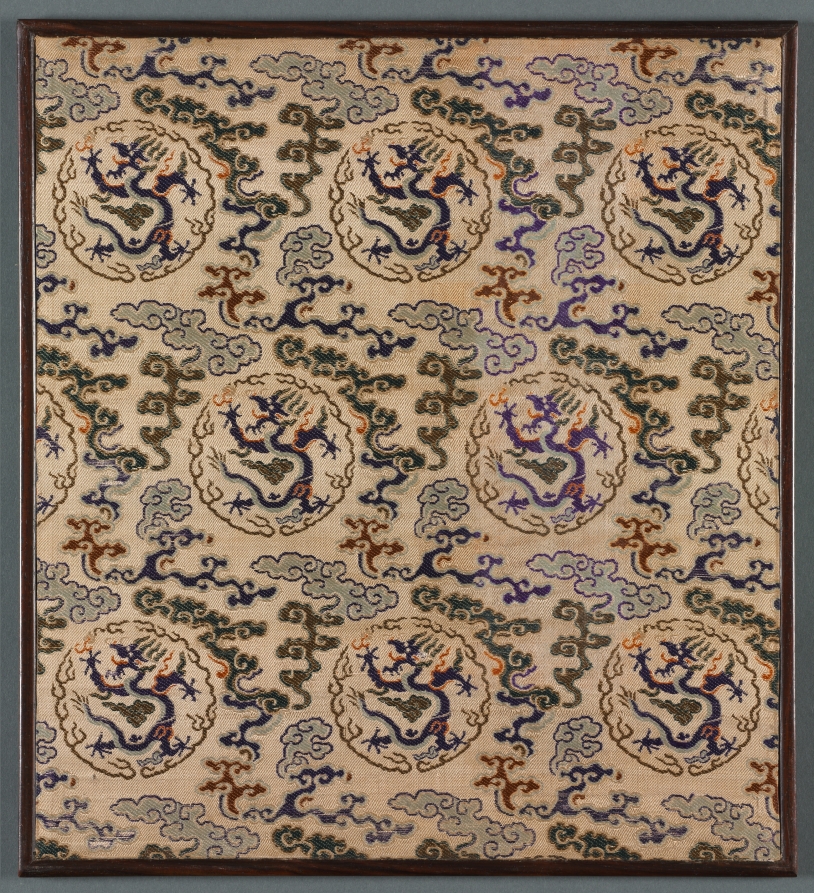
Given that Buddhism was introduced into Japan from China, and many Japanese priests and monks visited China as part of their training, it is understandable that the influence of China continued to be felt in Japan for centuries. Even during the Edo period, when Japan was all but closed to the outside world, there was still a reverence for things Chinese, as exemplified by the use of treasured Chinese fabric, perhaps once part of a robe, in this striking kesa. The five-clawed dragon indicates Chinese imperial production.
Be the first to share your thoughts.
Sign in to join the discussion.
More by Japan


More like this
 Manchu — Panel (Furnishing Fabric)
 Wang Gai (Chinese, active c. 1677–1705) — Album of Landscape
 China — Incomplete Carpet
 Manchu — Panel (Dress Fabric)
 Manchu — Panel
 Southern Germany, probably Württemberg — Table Carpet
 China, Possibly Macao — Panel (Dress Fabric)
 China — Fragments (Dress Fabric)
 Manchu — Uncut Yardage (Dress Fabric)
 Han-Chinese — Panel (Dress Fabric)
 Iran, probably Kashan — Fragment (Dress Fabric)
 China — Panel (Furnishing Fabric)