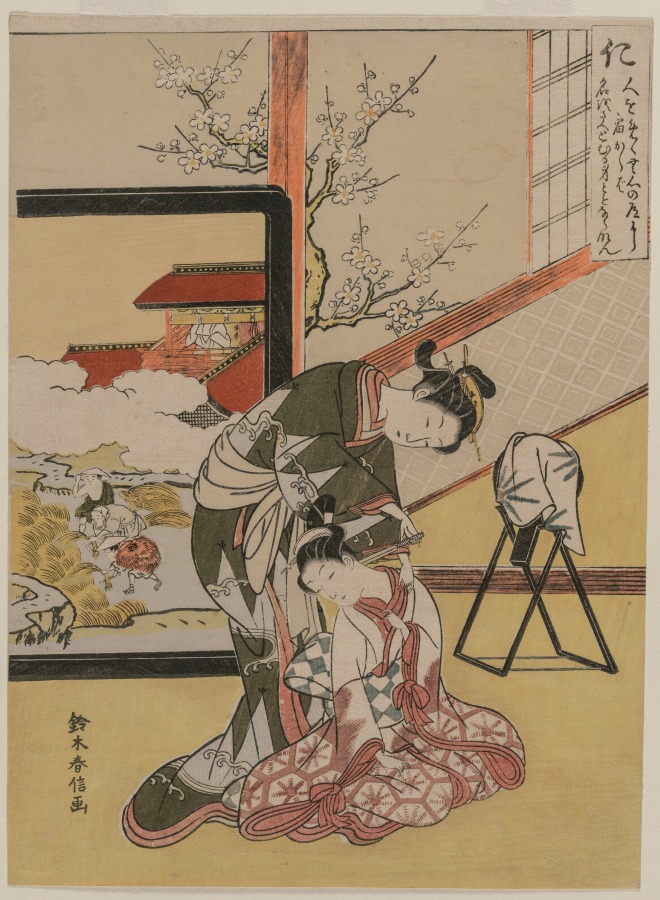
Parrot Komachi (Omu Komachi), from the series The Seven Fashionable Aspects of Komachi (Furyu yatsushi nana Komachi)
SEE IT IN PERSON
Not currently on view
In the collection of Art Institute of Chicago, Chicago · as of July 2026
Discussion
FROM THE ART INSTITUTE OF CHICAGO’S CATALOG
According to legend, poet Ono no Komachi received a letter from the emperor asking if she missed being at court. By changing only one character, Komachi was able to answer the question with an emphatic yes. This story is referred to as “Parrot Komachi” because of the bird’s talent for repetition. Here a courtesan hands a letter to her assistant, while a parrot is pictured on the standing screen behind her. As with many of the prints in this gallery, this image is a mitate-e (parody picture), in which the actions of modern figures refer to famed episodes in Komachi’s life. The poem written above reads: The cloud-capped palace Where I lived long ago Has not changed at all: But I saw through my bead curtains— Yes, I think fondly of that! (Translation by Louise Virgin
Be the first to share your thoughts.
Sign in to join the discussion.
More by Suzuki Harunobu





More like this
 Torii Kiyonobu II — The Actor Yoshizawa Ayame II as Hotoke G
 Unidentified
 Torii Kiyonaga — Young Man with Symbols of the First Dream o
 Katsukawa Shunsho — Act Two: The House of Kakogawa Honzo fro
 Ippitsusai Buncho — The Actor Onoe Matsusuke I as Oiso no To
 Kitagawa Utamaro (Japanese, c. 1754–1806) — Daimyō and his R
 Ippitsusai Buncho — The Actor Yamashita Kinsaku II as Moshio
 Ishikawa Toyonobu — Sanogawa Ichimatsu I as a puppeteer
 Kitagawa Utamaro — Ginjuro's Wife Oyumi from the Play "Whirl
 Katsukawa Shunsho — The Actors Ichikawa Monnosuke II and Seg
 Torii Kiyomitsu I — The Actors Sakakiyama Sangoro as the pag
 Isoda Koryusai — The Day of Starting (Kotohajime), from the