Laburnums and Battersea
1889/90 and 1898
Etching and drypoint in black, with selective wiping of plate tone, on ivory laid paper
34.2 × 22.1 cm (13.5 × 8.7 in)
SEE IT IN PERSON
Not currently on view
In the collection of Art Institute of Chicago, Chicago · as of July 2026
Discussion
FROM THE ART INSTITUTE OF CHICAGO’S CATALOG
For his early prints, Roussel adapted James McNeill Whistler’s methods to express his own interest in documenting the local scene, and Laburnums and Battersea is a striking example of the older artist’s influence. Roussel developed his plate through multiple states, used a variety of ink colors, and employed selective wiping to suggest differing effects of light, water, and mist. He also chose an upright format and a larger scale than his other prints depicting Chelsea and the Battersea factories on the opposite bank of the Thames River.
Be the first to share your thoughts.
Sign in to join the discussion.
More by Theodore Roussel



More like this
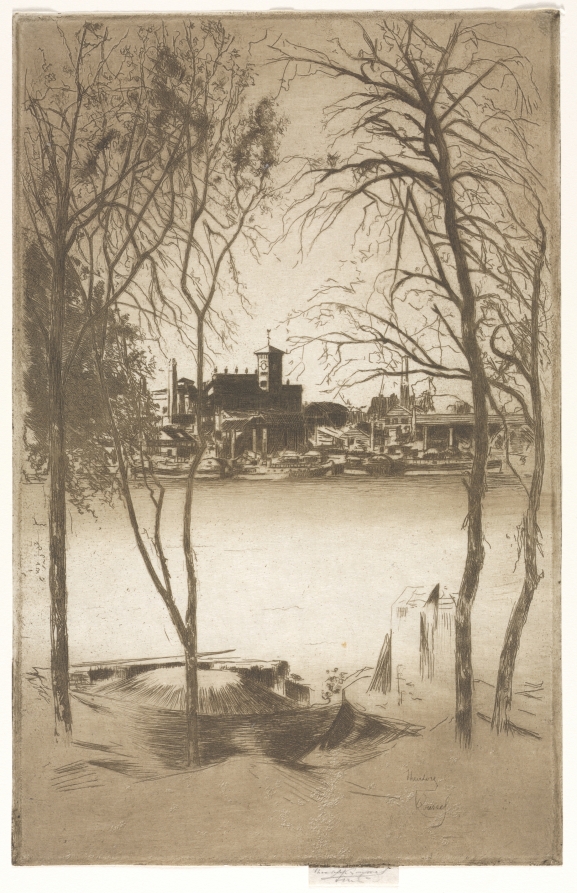 Theodore Roussel (French, 1847–1926) — Laburnums and Batters
 Gustave Leheutre (French, 1861–1932) — La grève désertée
 James McNeill Whistler (American, 1834–1903) — Long Venice
 James McNeill Whistler — Early Morning
 James McNeill Whistler — Charing Cross Bridge
 James McNeill Whistler — Long Venice
 Francis Seymour Haden — The Island Opposite Boyle's Farm
 Rodolphe Bresdin — Clump of Trees with a Village in the Dist
 James McNeill Whistler — Early Morning
 Francis Seymour Haden — Horsley's House at Willesley
 James McNeill Whistler — Little Putney Bridge
 Francis Seymour Haden — Brentford Ferry