Shirvan Kilim
SEE IT IN PERSON
Not currently on view
In the collection of Art Institute of Chicago, Chicago · as of July 2026
Discussion
FROM THE ART INSTITUTE OF CHICAGO’S CATALOG
Flat-woven rugs or covers from the Middle East, eastern Europe, central Asia, and India, kilims are usually made in the slit tapesty technique, in which slits occur where an area of one color meets an area of another. Stepping is introduced along these lines in order to keep slits small and avoid structural weakness. Stepped or serrated edges are thus a hallmark of much kilim production. Patterns are generally geometric in nature, in harmony with the structural characteristics. This kilim, made in the Shirvan area of the southern Caucasus (present-day Azerbaijan), has a pattern featuring shield-shaped devices that probably derive ultimately from vegetal or animal-skin forms. -A Global View: Recent Acquisitions of Textiles, 2012-2016, April 8-September 5, 2016
Be the first to share your thoughts.
Sign in to join the discussion.
More like this
 Southwest Caucasus — Sewan Kazak Rug
 Caucasus, Kuba District — Prayer Rug
 Turkey — Rug
 Spain; probably Murcia — Carpet
 Navajo (Diné) — Sarape with Terraced Zigzag Design
 Finland, Nummi, Hyrsylä — Carpet known as a "Ryijy" or "Rya"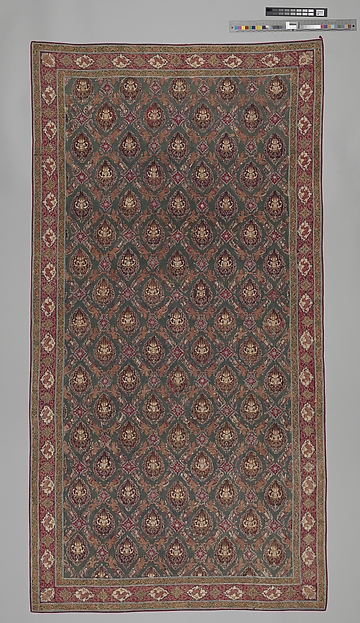
 Toraja
Indonesia, Sulawesi, Kalumpang — Ceremonial Hanging/S
Toraja
Indonesia, Sulawesi, Kalumpang — Ceremonial Hanging/S Morocco, Rabat — Carpet
 Saltillo, Coahuila, Mexico — Man's Sarape (Wearing Blanket)
 Khamseh — Khamseh Carpet
 Turkey — Cover