FROM THE CLEVELAND MUSEUM OF ART’S CATALOG
The style of this painting suggests that it comes from Catalonia in northeastern Spain, though the identity of its artist remains unknown. The painting represents a youthful bishop-saint identifiable by a bishop’s symbols of authority, his miter and crozier. He wears rich vestments. Below, the figure in black represents the donor of the painting—likely a wealthy layperson rather than a cleric. The identity of the saintly bishop is speculated to be Saint Louis, Bishop of Toulouse, on the basis of his youth. Louis was consecrated Bishop of Toulouse in 1297, died six months later at the age of 23, and was canonized in 1317. His relics were moved in 1423 to Valencia and his cult flourished in Spain.
Source ↗︎
Be the first to share your thoughts.
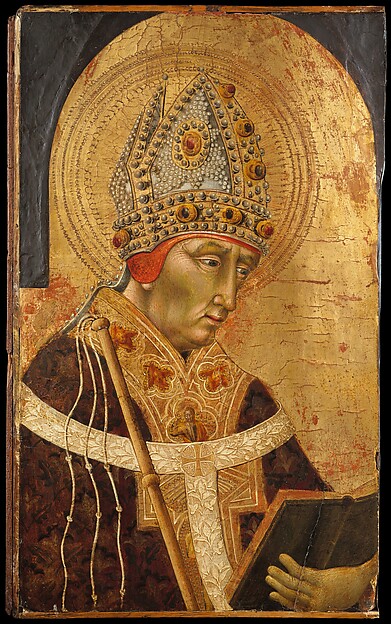 Giovanni di Paolo (Giovanni di Paolo di Grazia) — Saint Ambr
 Bartolomé Bermejo — Saint Augustine
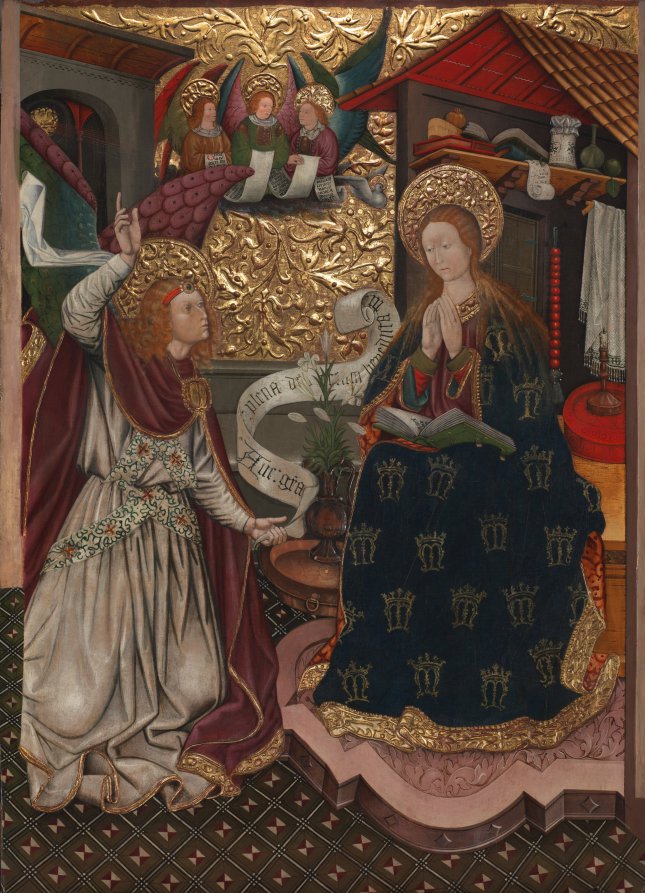 Jaume Ferrer the Younger (Spanish, Catalonia died c. 1460/70
 Master of San Torpè — Saint Julian
 Spanish Painter — The Mass of Saint Gregory
 Girolamo da Treviso I — St Bonaventure
 Antonello da Messina — Saint Gregor
 anonymous — Saint Sebastian
 Master of the Virgo inter Virgines — Saint John the Baptist
  Konrad Witz — St Bartholomew
 Konrad Witz — Ecclesia
 anonymous — Saint Ignatius of Antioch