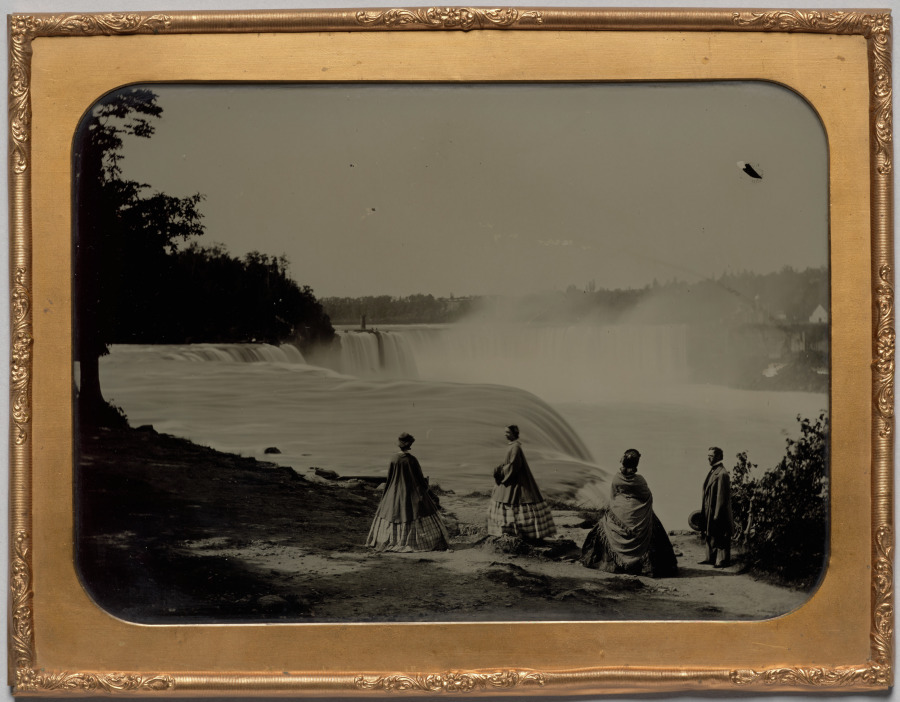
Untitled (Niagara Falls)
SEE IT IN PERSON
Not currently on view
In the collection of Art Institute of Chicago, Chicago · as of July 2026
Discussion
FROM THE ART INSTITUTE OF CHICAGO’S CATALOG
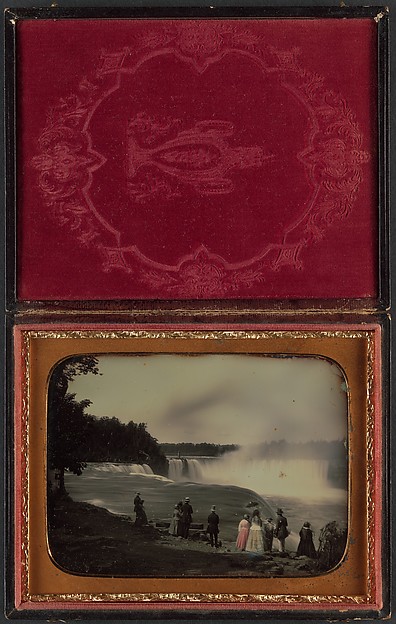
Niagara Falls, like other popular tourist destinations in the 19th century, was once only accessible through travel. With the invention and proliferation of photography after 1839, however, visitors could take home the scenes they saw. To create a daguerreotype—a small picture on silver-plated copper, nicknamed a "mirror with a memory"—a photographer painstakingly polished the plate, sensitized it in a bath of chemicals, and exposed it to light for a few seconds to several minutes. The resulting image was an irreproducible original with an unrivaled degree of sharpness. Tourists visiting Niagara Falls would have bought souvenir images like this one, which was likely made by the popular daguerreotypist Platt D. Babbitt, who sold his plates from a pavilion at Prospect Point. In order to maintain his monopoly, Babbitt supposedly thwarted the efforts of his rivals by waving umbrellas in front of the falls when they tried to make exposures.
Be the first to share your thoughts.
Sign in to join the discussion.
More by Platt D. Babbitt


More like this
![[Two Men Seated in a Horse-Drawn Carriage in Front of Niagara Falls]](https://images.metmuseum.org/CRDImages/ph/web-large/DP700286.jpg) Unknown — [Two Men Seated in a Horse-Drawn Carriage in Front
Unknown — [Two Men Seated in a Horse-Drawn Carriage in Front![[Family Posing on Bow Bridge, Central Park, New York]](https://images.metmuseum.org/CRDImages/ph/web-large/DP700454.jpg) Unknown — [Family Posing on Bow Bridge, Central Park, New Yo
Unknown — [Family Posing on Bow Bridge, Central Park, New Yo![[Mill or Warehouse with Vertical Clapboard Siding]](https://images.metmuseum.org/CRDImages/ph/web-large/DP700072.jpg) Unknown — [Mill or Warehouse with Vertical Clapboard Siding]
Unknown — [Mill or Warehouse with Vertical Clapboard Siding]![[Still-Life with Cockatoo, Ornamental Ball, Lace, Peacock Feathers]](https://images.metmuseum.org/CRDImages/ph/web-large/DP700248.jpg) T. R. Williams — [Still-Life with Cockatoo, Ornamental Ball,
T. R. Williams — [Still-Life with Cockatoo, Ornamental Ball, Addis's Lancaster Gallery — Elizabeth Michael Howell
![[Three Young Couples Dressed in Finery]](https://images.metmuseum.org/CRDImages/ph/web-large/DP700135.jpg) Unknown — [Three Young Couples Dressed in Finery]
Unknown — [Three Young Couples Dressed in Finery]![[Man Seated in Front of Cloud Backdrop, Books and Top Hat on Table]](https://images.metmuseum.org/CRDImages/ph/web-large/DP700216.jpg) Unknown — [Man Seated in Front of Cloud Backdrop, Books and
Unknown — [Man Seated in Front of Cloud Backdrop, Books and ![[Still-Life with Cockatoo, Mirror, Ornamental Ball, Vases, and Lace]](https://images.metmuseum.org/CRDImages/ph/web-large/DP700252.jpg) T. R. Williams — [Still-Life with Cockatoo, Mirror, Ornament
T. R. Williams — [Still-Life with Cockatoo, Mirror, Ornament![[Two Plasterers Leaning on a Railing]](https://images.metmuseum.org/CRDImages/ph/web-large/DP700442.jpg) Unknown — [Two Plasterers Leaning on a Railing]
Unknown — [Two Plasterers Leaning on a Railing]![[Painter Dipping Brush into Paint Jug]](https://images.metmuseum.org/CRDImages/ph/web-large/DP700304.jpg) Unknown — [Painter Dipping Brush into Paint Jug]
Unknown — [Painter Dipping Brush into Paint Jug] Unknown maker
American, 19th century — Untitled (Niagara Fal
Unknown maker
American, 19th century — Untitled (Niagara Fal![[Two Men, One in Military Garb, and a Woman, Seated Around a Table]](https://images.metmuseum.org/CRDImages/ph/web-large/DP700283.jpg) Unknown — [Two Men, One in Military Garb, and a Woman, Seate
Unknown — [Two Men, One in Military Garb, and a Woman, Seate