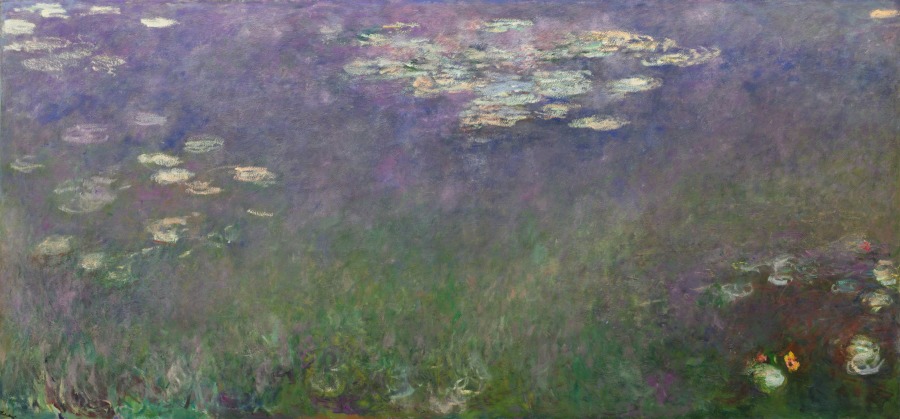
Water Lilies
SEE IT IN PERSON
Not currently on view
In the collection of Art Institute of Chicago, Chicago · as of July 2026
Discussion · 2
Top · NewestFROM THE ART INSTITUTE OF CHICAGO’S CATALOG
Little did Claude Monet know that the water garden he created three years after buying his Giverny, France, property in 1890 would become his primary inspiration over the next two and a half decades. These paintings, numbering around 250, mark Monet’s artistic journey from more straightforward depictions of the pond spanned by the wooden Japanese bridge to the monumental and near-abstract series on the water lily theme he made in preparation for his murals at the Musée de l’Orangerie in Paris between 1914 and 1926. Water Lilies , one of a group of paintings on the subject made between 1903 and 1908, comes at the midpoint of Monet’s developing style and spatial experimentations. The nearly square format underscores his move away from painting the conventional zones of land, sky, and water to focus solely on the water’s surface. Clusters of water lilies at bottom left and top right frame a watery path, while the water’s surface reflects trees and clouds. Although the dreamlike quality of floating forms might seem to be a natural development for the artist, he considered these works “an obsession,” a sentiment borne out by technical examinations on the Art Institute’s canvas, revealin
VOICES FROM HISTORY
“These landscapes of water and reflection have become an obsession. It is beyond my strength as an old man, and yet I want to render what I feel.”
— Claude Monet, letter to his friend Gustave Geffroy, August 1908
Sign in to join the discussion.
Eric Chen · 20d
The pink ones read as reflections of clouds at first. Then you realize they are the flowers. Then you are not sure again.
Amara Okafor · 21d
I keep this one open in a tab at work like a window. Five minutes of looking and my shoulders come down from my ears.