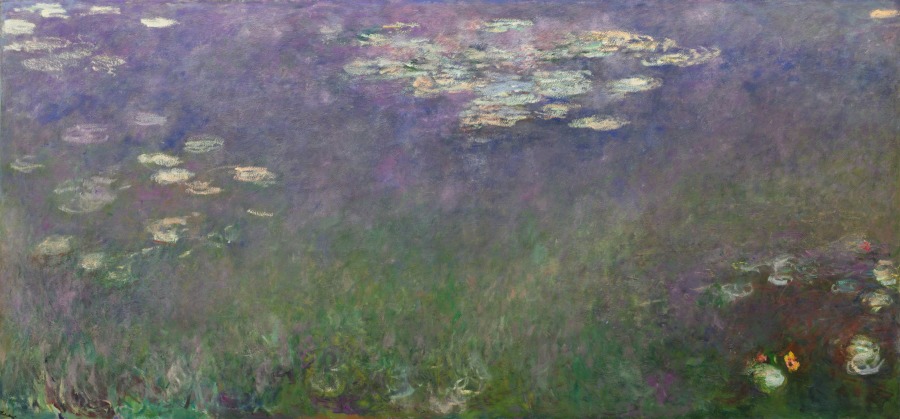
Water Lily Pond
SEE IT IN PERSON
● On view now — Gallery 243
Art Institute of Chicago, Chicago · verified July 2026
Discussion · 4
Top · NewestFROM THE ART INSTITUTE OF CHICAGO’S CATALOG
During World War I, after several years of inactivity because of bad health and grief over the death of his second wife, Claude Monet embarked on a period of intense work. Building a large studio and improving his garden, he began a group of monumental paintings of water lilies that he would later offer to the French state. Alongside this project, he painted a suite of 19 smaller canvases, including the present one. There is evidence—including a few photographs of the artist working in his garden—that Monet conceived these paintings outdoors and then reworked them in his studio. By this last stage of his career, however, the distinction between observation and memory in his work is intangible, and perhaps even irrelevant.
VOICES FROM HISTORY
“These landscapes of water and reflection have become an obsession. It is beyond my strength as an old man, and yet I want to render what I feel.”
— Claude Monet, letter to his friend Gustave Geffroy, August 1908
Sign in to join the discussion.

jim zaslaw · 5d
I fell in love with the water lilies while seeing them in real life at the Monet Museum in Paris.
Douglas Finch · 19d
No horizon, no sky, no bank. Just water. He quietly removed the ground you stand on and nobody complained.
Margaux Dubois · 21d
I grew up near Giverny and the ponds are still exactly this color in late June. He was not exaggerating — the light there really does dissolve everything.
Rebecca Stein · 20d
You grew up near Giverny?? I made the pilgrimage two summers ago and cried at the Japanese bridge like a complete tourist. No regrets.