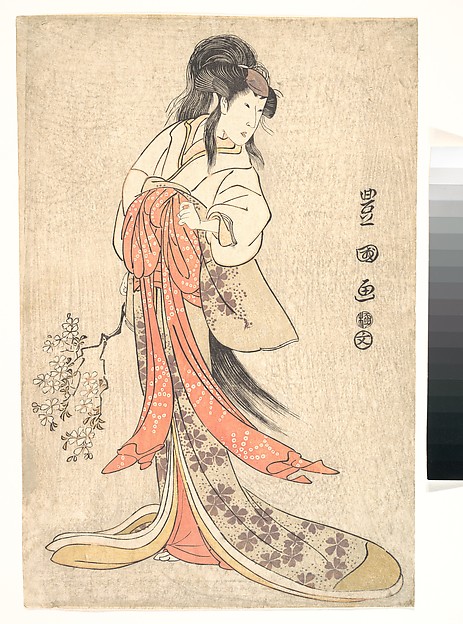
Onoe Shōroku I as the Ghost of the Shirabyōshi Hanako Standing over Osagawa Shichizō II as Tsumagi, Maid Servant to Sakurahime, in Uruō-ōgi Sumizome no Sakura
c. 1810
Color woodblock print; oban
36.4 × 24.7 cm (14.3 × 9.7 in)
SEE IT IN PERSON
Not currently on view
In the collection of Art Institute of Chicago, Chicago · as of July 2026
Discussion
FROM THE ART INSTITUTE OF CHICAGO’S CATALOG
The actor Onoe Shōroku I (1744–1815; also known as Onoe Matsusuke I) was known for playing supernatural roles, which often required quick changes of costume to transform from a beauty into a demon or ghost. This print documenting a performance at the Ichimura-za Theater in Edo (now Tokyo) tries to mimic the special effects of the Kabuki stage by including a flap of paper that hides the ghost the young woman transforms into.
Be the first to share your thoughts.
Sign in to join the discussion.
More by Utagawa Toyokuni I



More like this
 Kikukawa Eizan — Kisen Hoshi, from the series "Fashionable C
 Kikukawa Eizan — Ariwara no Narihira, from the series "Fashi
 Kitagawa Utamaro — The Poet Fun'ya no Yasuhide, from the ser
 Kikukawa Eizan — Evening Glow at Seta (Seta sekisho), from t
 Suzuki Harunobu (Japanese, 1724–1770) — Benevolence, from Th
 Kikukawa Eizan — Evening Glow at Seta (Seta sekisho), from t
 Kitagawa Utamaro — Hour of the Dragon (Tatsu no koku), from
  Kitagawa Utamaro — The joruri, Nure tsubame negura no karaka
 Kitagawa Utamaro II (Japanese, d. 1831?) — Chinese Embroider
 Kitagawa Hidemaro (Japanese) — Going to the Kabuki Theater i
 Suzuki Harunobu — Benevolence (Jin), from the series "Five C
 Utagawa Kuniyoshi — The actors Ichimura Uzaemon XII as Tada