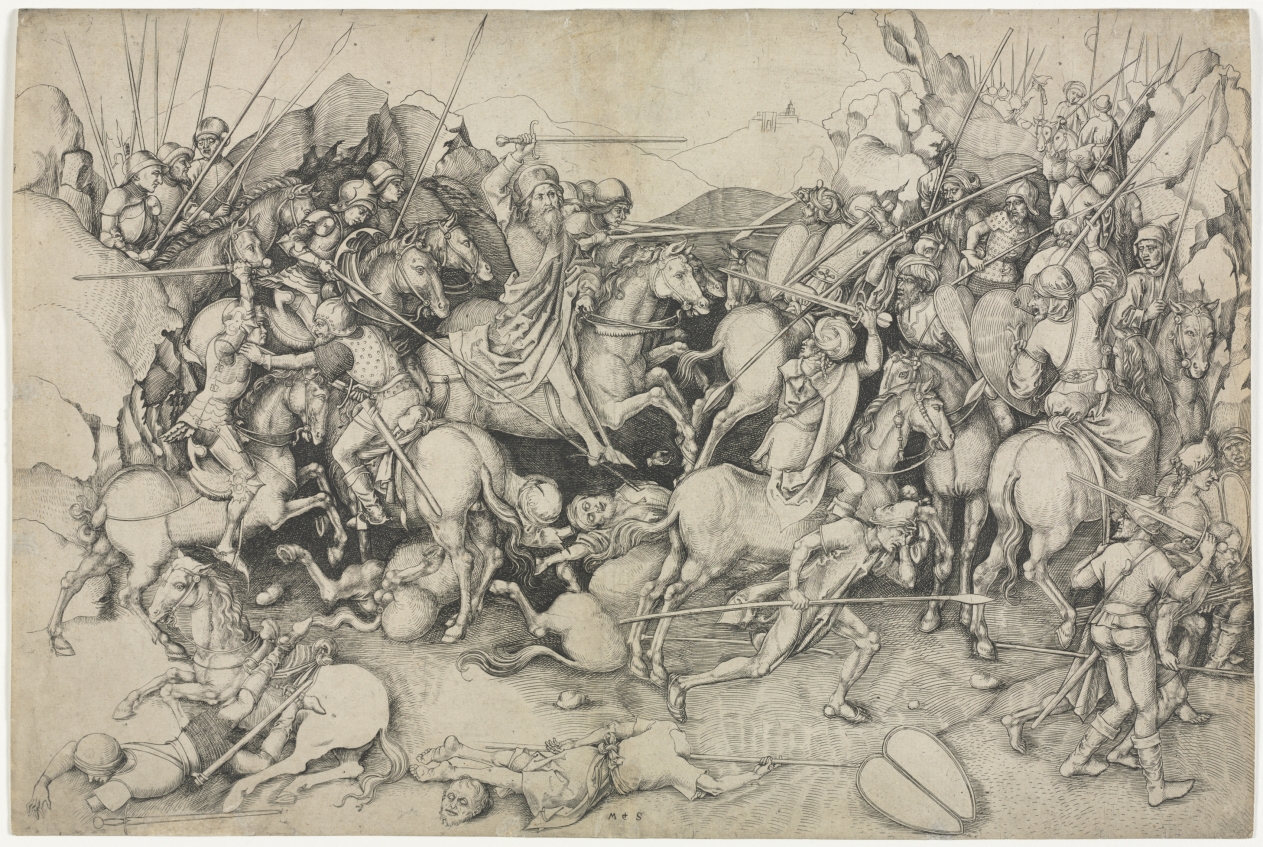
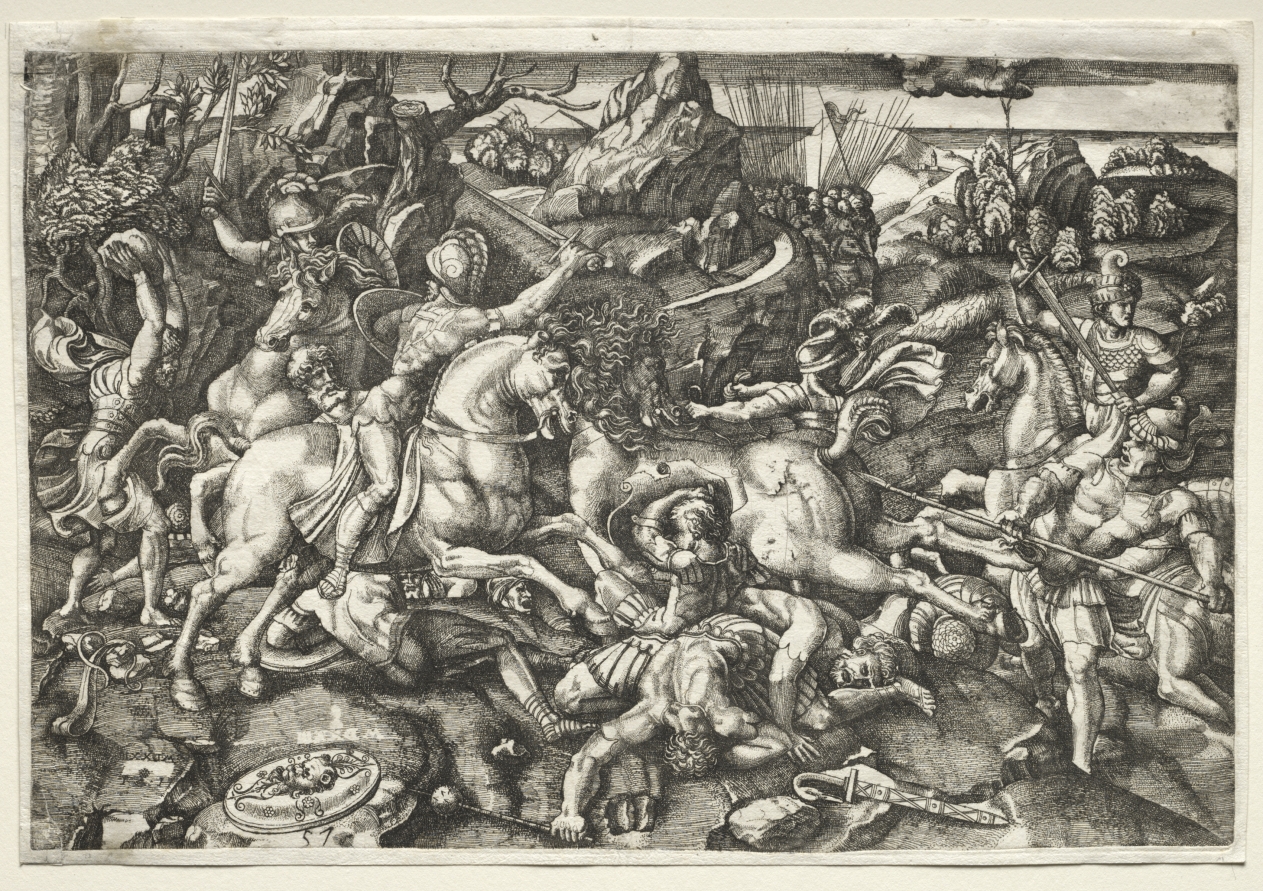
The Battle of St. James The Greater at Clavijo
n.d.
Engraving on paper
28.7 × 42.3 cm (11.3 × 16.7 in)
SEE IT IN PERSON
Not currently on view
In the collection of Art Institute of Chicago, Chicago · as of July 2026
Discussion
FROM THE ART INSTITUTE OF CHICAGO’S CATALOG
Saint James the Greater (died a.d. 44) was one of Christ’s apostles and the patron saint of Spain. He was said to have miraculously appeared, sword in hand, to help the Christian Spaniards defeat a Muslim army in a.d. 844—a battle that in fact never happened. The scene here abounds in gritty details such as the beheaded enemy corpse and various dismembered limbs. The saint wears a scallop shell on his hat, an allusion to the sign pilgrims wore on their long journey to revere his relics at the Spanish cathedral of Santiago de Compostela.
Be the first to share your thoughts.
Sign in to join the discussion.
More like this
 Martin Schongauer (German, c. 1450–1491) — The Battle of St.
 Martin Schongauer — St. James the Major at the Battle of Cla
 Albrecht Dürer — The Betrayal of Christ, from The Large Pass
 Master of the Year 1515 (Italian) — Battle in a Wood
 Albrecht Dürer — Knight, Death, and the Devil
 Hieronymous Hopfer — The Battle
 Hieronymus Hopfer|Domenico Campagnola — Battle between caval
 Hieronymus Hopfer (German) — Combat between horsemen
 Albrecht Dürer — Knight, Death, and the Devil
 Jean Duvet — A King Pursued by a Unicorn
 Pieter van der Heyden|Pieter Bruegel the Elder|Aux Quatre Ve
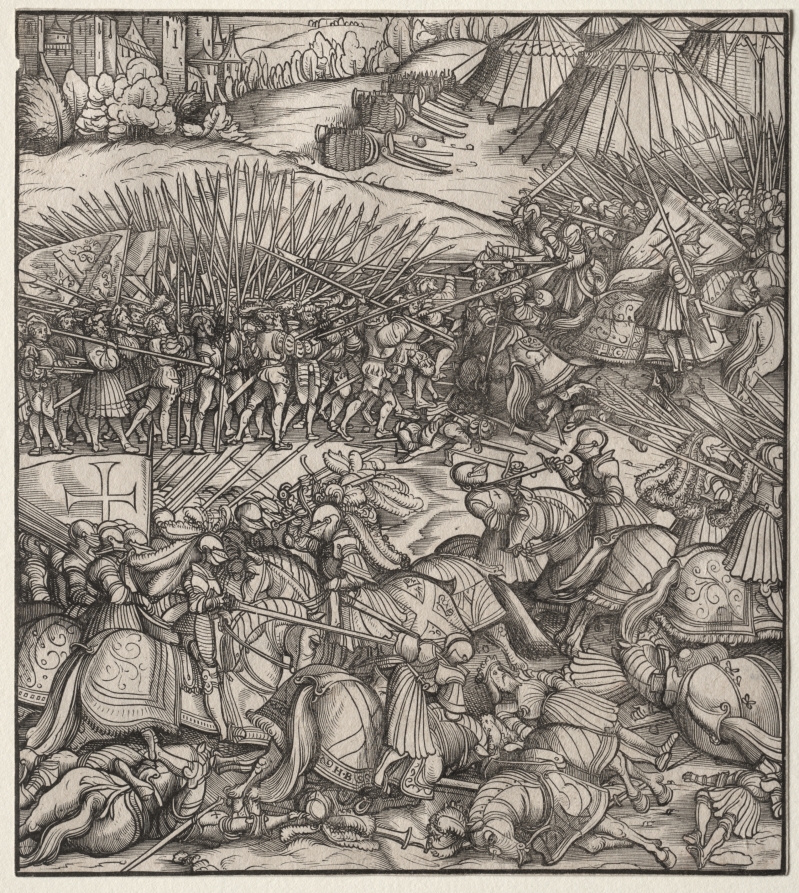 Hans Burgkmair (German, 1473–1531) — How the French King mad