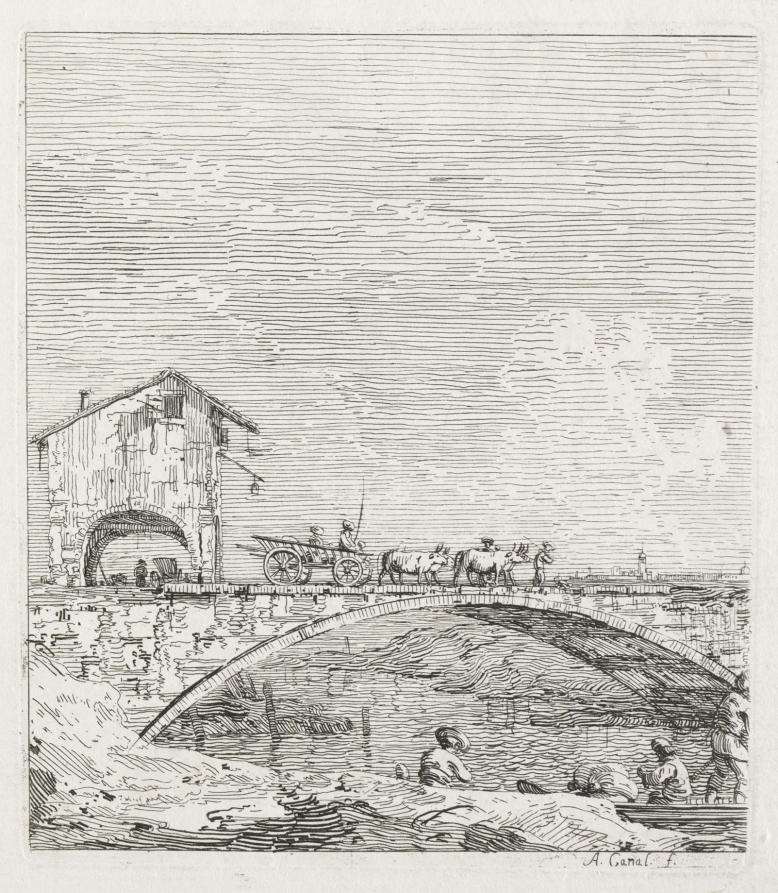
The Wagon Passing over a Bridge, from Vedute
1735/44
Etching in black on ivory laid paper
14.1 × 12.7 cm (5.6 × 5 in)
SEE IT IN PERSON
Not currently on view
In the collection of Art Institute of Chicago, Chicago · as of July 2026
Discussion
FROM THE ART INSTITUTE OF CHICAGO’S CATALOG
Unlike painting, printmaking allowed Canaletto to separate and combine images at his own discretion. He etched the outer two vignettes on a single plate before cutting it in two (for the other half, see 1922.1381.10). Then he reversed their order and positioned a third, unrelated segment between them (1922.1381.11).. Besides reusing fragments of larger plates, these mysterious composite prints appear to have little in common beyond the archways and statues they contain.
Be the first to share your thoughts.
Sign in to join the discussion.
More by Canaletto
More like this
 Antonio Canaletto (Italian, 1697–1768) — Views: A Wagon Pas
 Jean Jacques de Boissieu — Old Customs House, Rome
 Jean Jacques de Boissieu — The Monk and the Hunter
 Jacques Callot|Anonymous — Reverse Copy of Le Moulin a Eau (
 Charles Meryon — The Footbridge Temporarily Replacing the Po
 Canaletto (Giovanni Antonio Canal) — Woman drawing water fro
 Antonio Canaletto (Italian, 1697–1768) — Views: Mountain La
 Antonio Canaletto (Italian, 1697–1768) — Views: A Woman Dra
 Jean Jacques de Boissieu — View of Old Customs House in Rom
 Salomon Gessner — Procession through a Rustic Gate
 Antonio Canaletto (Italian, 1697–1768) — Views: The Portico
  Jean Jacques de Boissieu — Old Customs House on the Tiber