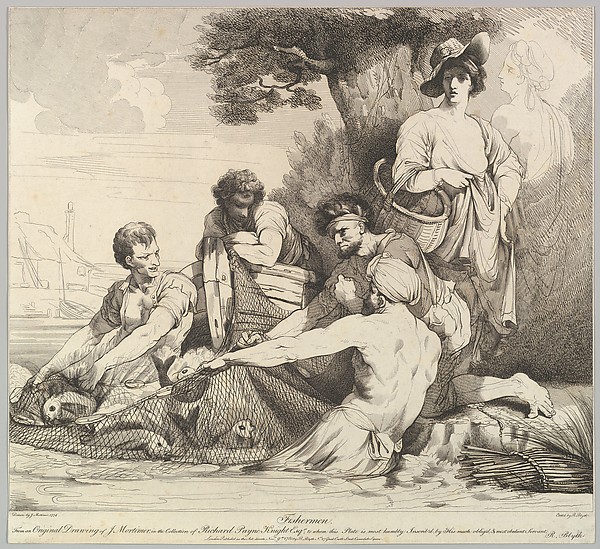
Fishermen
1880
Etching on cream laid paper
36.9 × 42 cm (14.5 × 16.5 in)
SEE IT IN PERSON
Not currently on view
In the collection of Art Institute of Chicago, Chicago · as of July 2026
Discussion
FROM THE ART INSTITUTE OF CHICAGO’S CATALOG
One of many prints executed by Mortimer's apprentice, Robert Blyth, this drawing reflects Mortimer’s interest in picturesque scenes of bandits, pirates, and smugglers. Blyth’s etching faithfully includes the vague or unfinished elements in the periphery of the drawing , including the house at the right margin and the seemingly allegorical female figure on the left. As a natural outcome of translating a drawn invention onto a printing matrix, the etching reverses the direction of Mortimer’s drawing.
Be the first to share your thoughts.
Sign in to join the discussion.
More like this
 John Hamilton Mortimer — Fishermen
 John Hamilton Mortimer|Robert Blyth|Richard Payne Knight — F
 Giovanni Battista Tiepolo — Two Soldiers and Two Women, from
 Giovanni Battista Tiepolo (Italian, 1696–1770) — Various Cap
 John Hamilton Mortimer — Classical Subject: Possibly the Aft
 Francesco Primaticcio|Léon Davent — Jupiter Pressing the Sto
 Francesco Fontebasso — Satyr with Club and Seven Figures, fr
 Giovanni Battista Tiepolo — The Discovery of the Tomb of Pun
 Pietro Monaco|Francesco Maffei — Job rebuked by his wife
 Francesco Fontebasso — Satyr with Club and Seven Figures, fr
 Giovanni Battista Tiepolo (Italian, 1696–1770) — Scherzi di
  Joseph Anton Rhomberg — The Mourning of the Dead Abel