United States, New England or Mid-Atlantic
Bedcover
SEE IT IN PERSON
Not currently on view
In the collection of Art Institute of Chicago, Chicago · as of July 2026
Discussion
FROM THE ART INSTITUTE OF CHICAGO’S CATALOG
During the late 18th and early 19th centuries, England maintained restrictions on the export of textile-related technology and expertise. Copperplate engraving required specialized training, limiting its widespread use. The age-old tradition of printing with blocks continued in the United States. In this bedcover the blocks were used to apply the resist before the textile was dyed with indigo. Prior to the Revolutionary War, indigo cultivation for export was a profitable enterprise in South Carolina, though this would later be supplanted by the cotton industry.
Be the first to share your thoughts.
Sign in to join the discussion.
More like this
 Iran, probably Kashan — Fragment (Dress Fabric)
 England — Panel (Furnishing Fabric)
 Piece
Piece France, Lyon — Panel (Intended as Dress Fabric)
 Bannister Hall Print Works — Plum Trees and Pheasants (Furni
 France or England — Panel
 Anna Maria Garthwaite — Panel
 Anonymous — Red book cover with black and white floral patte
 Piece
Piece John Lowe & Co.|Stinton Bros. — Piece
 Panel
Panel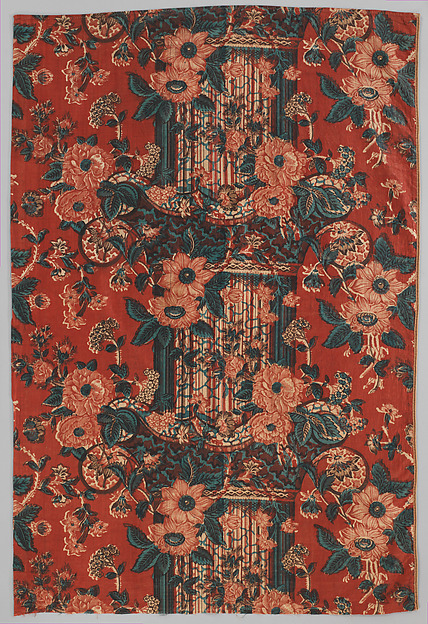 Piece
Piece