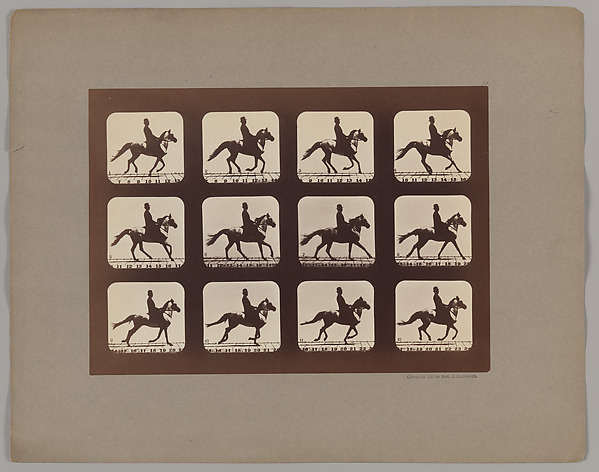
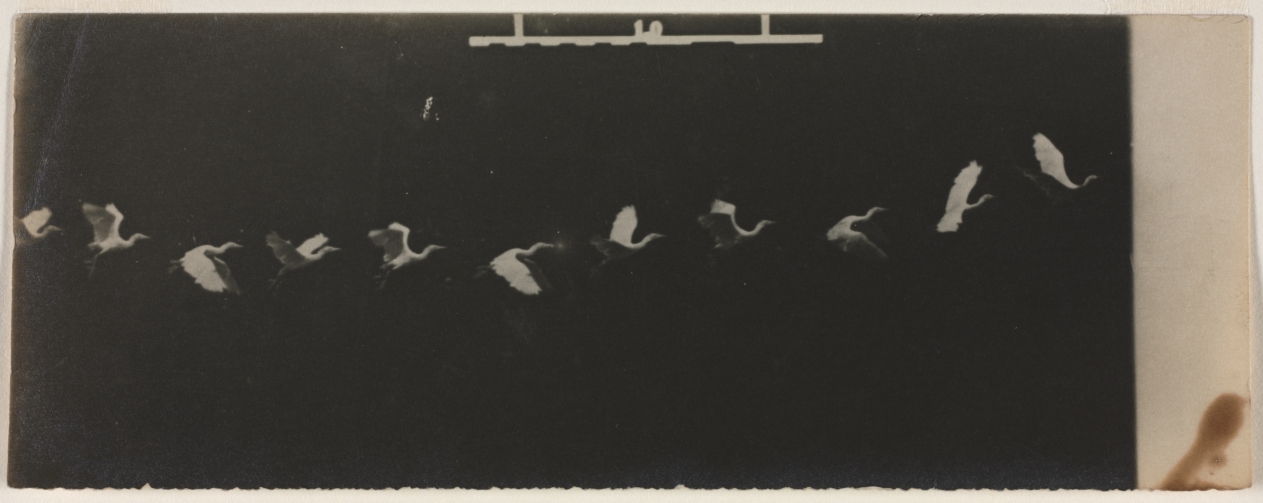
Animal Locomotion, Plate 758
SEE IT IN PERSON
Not currently on view
In the collection of Art Institute of Chicago, Chicago · as of July 2026
Discussion
FROM THE ART INSTITUTE OF CHICAGO’S CATALOG
In the late 1870s, Eadweard Muybridge pioneered a method of "instantaneous photography," a technique developed to freeze time by capturing motion. In order to create such sequences, he set up a battery of cameras, 24 in this instance, connected by a clockwork mechanism that triggered the shutters one by one at rhythmic intervals. Muybridge initially devised this process to clarify the movement of horses; through his experiments, he demonstrated that all four hooves leave the ground mid-gallop, thereby settling an intense debate of the era. This print of a cockatoo in flight was originally published in Animal Locomotion , a portfolio of 781 separate series that Muybridge, working under the auspices of the University of Pennsylvania, created to stand at the intersection of art and science.
Be the first to share your thoughts.
Sign in to join the discussion.