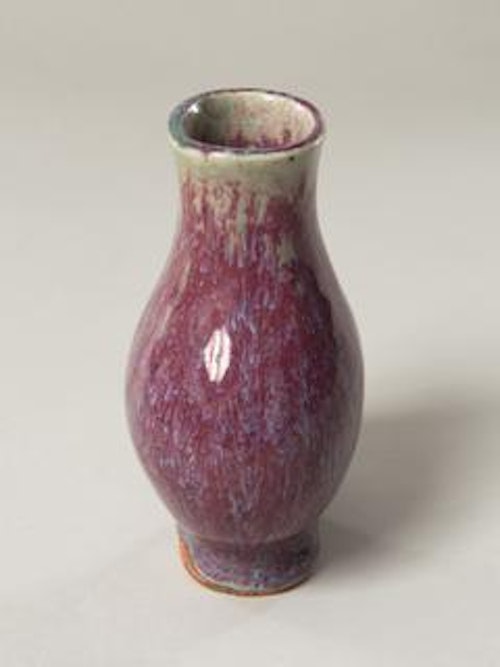
Bottle-Shaped Vase
SEE IT IN PERSON
Not currently on view
In the collection of Art Institute of Chicago, Chicago · as of July 2026
Discussion
FROM THE ART INSTITUTE OF CHICAGO’S CATALOG
This vase’s rich glaze was created when a potter fired it in a kiln with restricted oxygen at a high temperature. The copper oxides in the glaze transformed unpredictably into streaks of crimson, violet, and blue to create what is known as “flambé glaze.” Potters carefully manipulated kiln conditions in this process, called reduction firing, yet embraced the chance effects that gave each piece its unique, flame-like character. These striking results captivated European collectors, and ceramicists such as French artist Taxile Doat sought to reproduce the fluid, iridescent effects in their own work in the 18th and 19th centuries.
Be the first to share your thoughts.
Sign in to join the discussion.
More by China


More like this
 Unidentified Maker — Vase
 Korea — Bottle with Bamboo Fluting
 England, Staffordshire — Vase
 American Flint Glass Manufactory — Pocket bottle
 Probably Miotti Glasshouse (Italian, active c. 1730–c. 1747)
 Korea — Bottle-Shaped Vase with Lotus Flowers and Stylized S
 Artist unknown — Bottle
 Pierre Adrien Dalpayrat — Vase
 Ancient Roman — Bottle
 Albert Robert Valentien — Vase
 Ernest Chaplet — Vase