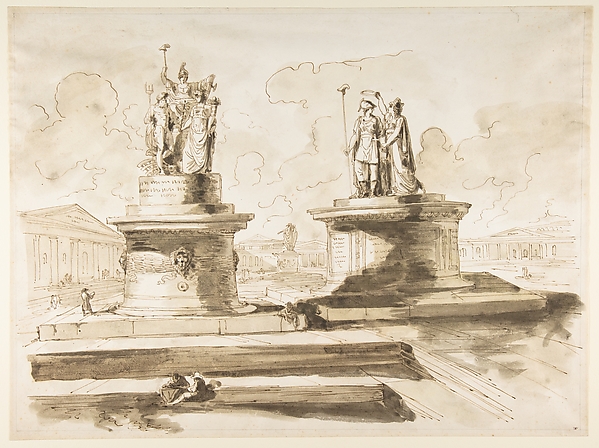
Hubert Robert

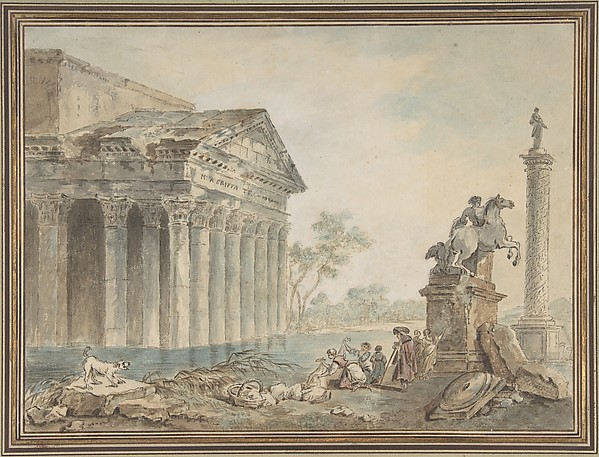
Equestrian Statue of Marcus Aurelius

1757
Pen and black ink, brush and gray and brown wash, pale rose watercolor and white heightening over black chalk.
48.4 × 58.8 cm (19.1 × 23.1 in)

SEE IT IN PERSON

Not currently on view

In the collection of The Metropolitan Museum of Art, New York · as of July 2026

View at metmuseum.orgPlan a visit ↗

Discussion

Be the first to share your thoughts.

Sign in to join the discussion.

Community guidelines

More by Hubert Robert

The Bathing PoolThe Bathing PoolThe Mouth of a CaveThe Mouth of a CaveThe DanceThe DanceBridge over a CascadeBridge over a CascadeWandering MinstrelsWandering MinstrelsA Colonnade in RuinsA Colonnade in RuinsThe Landing PlaceThe Landing PlaceThe FountainsThe Fountains

More like this

Architectural Capriccio with Roman Monuments and WasherwomenHubert Robert|Hubert Robert — Architectural Capriccio with RRecto:  Phantasie und Künstler (Imagination and the Artist); Verso:  Studie zu Phantasie und Künstler (Study for Imagination and the Artists)Max Klinger — Recto: Phantasie und Künstler (Imagination anUnexecuted Design for the Monument to the First Duke of MarlboroughJohn Michael Rysbrack — Unexecuted Design for the Monument tVeduta del Boschetto d'Arcadia dalla parte del TempioEnnemond Alexandre Petitot — Veduta del Boschetto d'Arcadia Unexecuted Design for the Monument to the First Duke of MarlboroughJohn Michael Rysbrack — Unexecuted Design for the Monument tDesign for a Painted Wall DecorationFrancesco Stagni — Design for a Painted Wall DecorationRuins, with a Statue on the LeftGiovanni Paolo Panini — Ruins, with a Statue on the LeftArtist Among RuinsAntonio Zucchi — Artist Among RuinsHector's Farewell to Andromache and AstyanaxSebastiano Galeotti — Hector's Farewell to Andromache and AsFrontispiece, with Statue of Minerva, from "Vedute di Roma"Giovanni Battista Piranesi — Frontispiece, with Statue of MiFigures in Classical RuinsGiovanni Paolo Panini — Figures in Classical RuinsRoman Ruins with Two Peasants Conversing in the ForegroundCharles Louis Clérisseau — Roman Ruins with Two Peasants Con